Cancer Diagnosis: How to Take Back Control
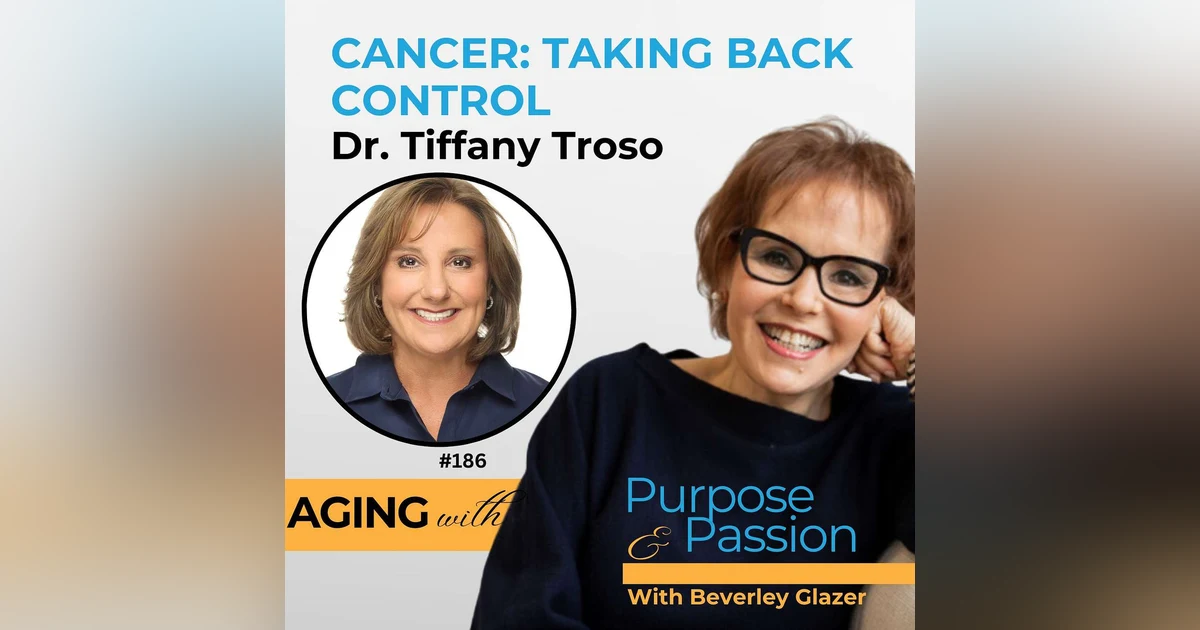
The scariest part of a diagnosis isn't always the disease. It's realizing you have to make life-changing decisions when you're scared, exhausted, overwhelmed, and unsure what questions to ask next. In this episode of Aging With Purpose and Passion, Beverley Glazer sits down with Dr. Tiffany Troso, an oncologist with more than 25 years of experience helping women navigate breast cancer, gynecologic cancer, treatment decisions, and the emotional challenges that come with a cancer diagnosis. Pat...


The scariest part of a diagnosis isn't always the disease.
It's realizing you have to make life-changing decisions when you're scared, exhausted, overwhelmed, and unsure what questions to ask next.
In this episode of Aging With Purpose and Passion, Beverley Glazer sits down with Dr. Tiffany Troso, an oncologist with more than 25 years of experience helping women navigate breast cancer, gynecologic cancer, treatment decisions, and the emotional challenges that come with a cancer diagnosis.
Patients often leave medical appointments with information.
But not always with clarity.
Dr. Troso explains how to become a more empowered patient, communicate effectively with your healthcare team, get the most from medical appointments, and make confident healthcare decisions when the stakes feel overwhelming.
We discuss:
• Breast cancer and gynecologic cancer
• Patient advocacy and self-advocacy
• Questions to ask after a cancer diagnosis
• Why second opinions matter
• Understanding treatment options
• Organizing medical records and test results
• Managing fear, uncertainty, and overwhelm
• Building confidence during treatment
• Caregiving and support during cancer
• Navigating the healthcare system
Dr. Troso also shares her own story of reinvention after being diagnosed with a neurodegenerative eye disease—an experience that transformed her understanding of resilience, patient care, and what people need most when life changes unexpectedly.
If you've ever faced a serious diagnosis, cared for someone you love, or felt overwhelmed by medical decisions, this conversation will help you move from confusion to clarity and from fear to informed action.
Because taking back control doesn't start with having all the answers.
It starts with asking the right questions.
SUBSCRIBE
If this episode helped you, please share it with a friend, leave a review to help more women find the information and support they need, when it matters most.
Resources:
For similar episodes on empowering yourself with cancer, check out Creating the 5% Odds, episode 164, and When Life Breaks You Open Episode 178 of Aging with Purpose and Passion. And if you like podcasts for older women, Women Over 70 is a powerful force. These compelling stories shatter the myth that we're irrelevant as we age. womenover70.com.
Dr. Tiffany Trosso-Sandoval, MD – Oncologist, Author & Founder of the Empowered Cancer Patient Community
🌐 http://www.drtiffanytroso.com
💼 https://www.linkedin.com/in/drtiffanytroso
📘 https://www.facebook.com/ttrososandoval
📸 https://www.instagram.com/drtiffanytroso/
▶️ https://www.youtube.com/@drtiffanytroso?sub_confirmation=1
Beverley Glazer, MA, CCC, ICF – Life and Business Transition Coach & Host
🌐 https://reinventimpossible.com
💼 https://www.linkedin.com/in/beverleyglazer/
📘 https://www.facebook.com/beverley.glazer
👥 https://www.facebook.com/groups/womenover50rock
📸 https://www.instagram.com/beverleyglazer_reinvention/
🎁 BONUS: Tired of 3 AM Overthinking? Get the "Stuck to Unstoppable" Roadmap and receive my weekly strategic insights for women 50+ delivered to your inbox every weekend. GET THE FREE RESOURCE Here: https://reinvent-impossible.aweb.page/from-stuck-to-unstoppable
Have feedback or a powerful story that's worth telling? Contact us at info@Reinventimpossible.com
00:00 - Welcome: How to Take Back Control After Diagnosis
01:23 - Meet Dr. Tiffany Toroso: Oncologist and Patient Advocate
02:32 - Early Life, Science, and the Path to Medicine
03:35 - A Family Cancer Story That Shaped Her
05:05 - Finding Her Calling in Breast and Gynecologic Cancer Care
06:26 - What Cancer Patients Need Most: Clarity and Support
08:19 - Her Diagnosis And A Hard Pivot
09:34 - Closing the Gap Between Cancer Treatment and Real Life
12:17 - Answering The Question Everyone Fears
13:04 - Creating The Empowered Cancer Patient Community
14:50 - Calming the Cancer Chaos: The Book Patients Need
16:18 - Biggest Mistakes And Second Opinions
17:59 - Patient Advocacy: Put Yourself First and Reduce Overwhelm
20:29 - Cancer Takeaways and Practical Next Steps
21:47 - Resources, Support, and Where to Find Dr. Toroso
Welcome: How to Take Back Control After Diagnosis
AnnouncerWelcome to Aging with Purpose and Passion, the podcast designed to inspire your greatness and thrive through life. Get ready to conquer your fears. Here is your host, psychotherapist, coach, and empowerment expert, Beverley Glazer.
Beverley GlazerWhat if the most important thing a doctor could do is not give you medication, but the confidence to take back your control? Welcome to Aging with Purpose and Passion. I'm Beverley Glazer, a work and life transition coach and reinvention strategist for women over 50 to help you turn a lifetime of wisdom into your most impactful next act. And you can find me and these podcasts on reinventimpossible.com. These episodes share powerful stories from women who refuse to shrink, settle, or disappear with age. We don't sugarcoat our challenges here. We rise through them. And you'll leave with a stronger belief in yourself and greater clarity about what's still possible for you, too.
Meet Dr. Tiffany Toroso: Oncologist and Patient Advocate
Beverley GlazerDr. Tiffany Troso is an oncologist who spent 25 years at Memorial Sloan Kettering Cancer Center, one of the most respected institutions in the world. And then she faced her own health challenges, which changed the trajectory of her career. Today she's on a mission to help women become empowered patients through education, advocacy, and knowledge that gives them back a sense of control during some of the hardest moments of their lives. If you've ever felt dismissed, overwhelmed by the system, or afraid to ask your doctor the right questions, this conversation is for you. And stay with us until the end, and I'll be sharing some takeaways and actions that you can begin for your life right now. So welcome, Dr. Tiffany.
Dr. Tiffany TrosoThank you so much. This is wonderful. I am so excited because your platform is reaching the exact people that I want to talk to. So thank you so much for having me here.
Beverley GlazerVery welcome. You have so much information to share.
Dr. Tiffany TrosoYes.
Early Life, Science, and the Path to Medicine
Beverley GlazerDid you grow up in a medical family? What was it like for you as a little girl?
Dr. Tiffany TrosoNo, there are no doctors, no medicine in my family. Um, my dad was a self-made um CEO on Wall Street. He kind of climbed his way up from the mail room, so to speak, which I know you can't do anymore, but back in the day, he uh yeah, he really did. Um my mom was uh a stay-at-home mom, but she also had a degree in um design. And she went to college actually and got a degree when I went to college. And so that was wonderful. Um, so no, I I grew up on Long Island in a you know middle class family. I went to public high school and then I went, I played soccer. Um, and that helped me get into Princeton. So I went to Princeton University where I studied molecular biology.
Beverley GlazerAnd no medicine?
Dr. Tiffany TrosoNo medicine, nope. But I found molecular biology because I love science. I was always a science kid. Um, and so yeah, it led itself perfectly into my later career.
Beverley GlazerYeah.
A Family Cancer Story That Shaped Her
Beverley GlazerWhen did you first see how illness affects the family? Oh my goodness.
Dr. Tiffany TrosoI can bring you back all the way till when I was six or seven years old when my grandma, my mom's mother, was dying of thyroid cancer. I remember being in her apartment when we went over for dinner, and they were everybody was touching her neck. She had this big hard nodule in her in her neck, and it was in her thyroid. And so, fast forward, she's in treatment, and I used to sit in the back of my mom's white Pontiac with the red pleather seats, and she would leave me outside in the summer in the car. I think she cracked the windows a little bit last week, as they did in the 70s. And um, you know, she but she would always she'd bring my grandmother in for her treatment, and then she'd come out and wait with me in the car and always was so upset and frustrated by the fact that none of the doctors wanted to talk to her. She couldn't get a straight answer from anybody. And she was always so frustrated and upset by the whole thing, which is horrifying considering she was already upset about my grandmother obviously being so ill. My grandma passed away at my house, actually in my bed. Um she was staying in my bedroom when I was a little girl, and it was so sad because she was really a special woman. I certainly at that time didn't know I was going to be an oncologist, but it left an indelible, you know, crease in my heart that I knew I just never wanted to be somebody that would make someone like my mother cry. So, you know, when I did decide to be an oncologist and become a doctor in general, I knew the kind of doctor I wanted to try and be.
Finding Her Calling in Breast and Gynecologic Cancer Care
Beverley GlazerSo, how did that come about?
Dr. Tiffany TrosoSo the molecular biology at Princeton definitely led to it because back in 87 through 91, while I was there, molecular biology was the study of DNA and the genes. And we were just identifying the oncogenes, the genes, the abnormalities that cause cancer back then. And so it was cutting edge and it was so brilliant. Um, and it led itself perfectly into medicine. So I went to Cornell Medical School in Manhattan and we did lots of rotations through Memorial Sloan Kettering across the street. And I just found my calling. I did internal medicine residency, and although it was very interesting and there's so much to learn, and it was busy and all the things, I really was drawn to oncology because it felt like a place where I could really make a very big difference in somebody's life. Um, and I was drawn to women's oncology and specifically like breast and gynecological cancer because I love taking care of women. Um, I've always been a very social type of a person, and I love my girlfriends and I love talking to women and helping people that I can relate to. And so it was actually a natural marriage for me to go into women's oncology.
Beverley GlazerAnd you spent 25 years doing this.
Dr. Tiffany TrosoYes, I did. Yes, I did. Thousands and thousands of patients.
What Cancer Patients Need Most: Clarity and Support
Beverley GlazerYeah. What did those patients teach you?
Dr. Tiffany TrosoThey taught me a lot, and a lot of it's in my book, which I'm sure we're going to get into. But um, you know, it took it took time. It took time. When you're a baby doctor and you're still finding your voice as a physician, you would, you know, give your recommendations and see how they would land and see how the patients responded. And over time you learn what was really helpful for the patients, what they could really comprehend, and what they really needed from you. And, you know, it it it was a it was a time that I really was developing again who I was as a physician. And it probably crystallized more later on in my career, as well as after I had my own medical illness and had to retire. What patients really need is not necessarily what we were in the exam room to give them. In other words, we have all this medical knowledge that we need to expire to teach them, and the patients have their own agenda. They want to understand where does this fit in my life? Where does my life trajectory go? And how do I manage all of this chaos that just fell into my lap that I wasn't expecting? And so a lot of what I've done since leaving MSK was to develop a platform and a brand that is looking to close that gap between what physicians are giving and what patients actually need. Because it's a huge, it's a huge gap in oncology care, as well as probably in a lot of medical subspecialties as well.
Beverley GlazerBut just having to switch like that when you love medicine, when you love dealing with the patient, when you love, you know, the research. And how did that hit you when you had your own medical issue?
Dr. Tiffany TrosoSo,
Her Diagnosis And A Hard Pivot
Dr. Tiffany Trosoyou know, that's interesting. I attacked it a little bit like a doctor. Um, I knew I knew everything about the disease. I have an eye disease. It's called macular telangictasia. It's a slow neurodegenerative eye disease. I'm losing my vision. Um, and I attacked it, like I said, like a physician, like a scientist. And I knew probably as much about the disease as the doctor that was treating me, if not more. I would, I used to text him because doctors, you know, would exchange each other's phone numbers. But I would text him when a new study came out or if I heard about something that I thought would be beneficial for me. And sometimes I was letting him know before he did. Um, but you know, I think that it also made me realize that it was really important to try to figure out how to live my life with the disease. And that was something that I've tried to share with my patients as well. I used to say that I wasn't going to let this disease define who I was. Well, it unfortunately advanced to the point where it kind of did, and I did retire, but I've pivoted and I've pivoted hard. And I am now in a space where I feel that I'm almost reaching or helping more people on a day-to-day basis than I even could in the clinic.
Closing the Gap Between Cancer Treatment and Real Life
Beverley GlazerYeah, let's talk about that, because that is so important. And the first thing is what kind of stories can you tell where you really felt that women had to be empowered. They had to know what's going on behind the scenes. A lot of doctors keep this a secret, or they'll be very curt, and you're anything but. So they share that.
Dr. Tiffany TrosoWell, I mean, my goodness, after 25 years, the number of stories I could tell you, um, you know, for example, I do describe this in in the book at some point, um, about how, you know, I would be speaking to a young woman, 40-something, who's got a kid, you know, a 12-year-old is sitting in the corner, annoyed and bored by being there. And the patient was clearly really anxious and could jump out of her skin at any moment. And I'm telling her about the treatment recommendations for her stage two breast cancer, and the daughter's, you know, humming and hawing in the corner. And I get through my whole explanation and I hand her, you know, I always wrote hand wrote out notes about what I was talking about so that they could bring something home. And then I asked her a question, and it became very clear to me that she didn't absorb one thing I had said to her. And I took a step back and I realized that, you know, she had so many other things going on that yes, her life is important to her, of course, but her daughter was there and her son she needed to pick up from Little League, and her mother's sick, and her husband wants dinner on the table at seven o'clock. And she has all of these, and then you know, she took a leave of absence from her work and she didn't know when she was going to go back, and all the things that are flowing through her head. And so I'm explaining disease stages and disease treatment options with chemotherapy and what have you. And the number one question she really wanted to answer is am I gonna die? And you know, it really makes you take a step back and realize that yeah, they need to know all of the medicine that I'm trying to teach them, but we really need to address their here and now and their life and the things that are actually going on. And yeah, I, you know, I had I brought her back again and I sat down without her daughter in my office and we went through it again. And I, you know, we'd explain things to her, and then I'd have her what's called a teachback method. I would have her explain back to me what she heard so that I was sure she really understood. Um, so that's you know, just one example, but that's the kind of thing that you know you realize that they don't teach you that in medical school. They don't, you know, and you just you kind of learn it by practice and realizing that you have to really look into the lives of your patients and understand them as a full person before they can really even begin to listen to your treatment recommendations.
Answering The Question Everyone Fears
Beverley GlazerSo yeah. And what can you tell a patient who looks you right in the eye and says that hard question, am I going to die?
Dr. Tiffany TrosoSo obviously, you know, when you're speaking to a patient, there are also there are all different types of cancers and stages. And so how I answer the question is is always a little bit differently, but I never give a statistic because no patient that sits in front of me is going to be a statistic. I'll talk about trends, I'll talk about the things that we can do for them, and I'll tell them that, you know, there's always a chance that something's not going to work. But I am here for you, and I'm going to work with you to make sure that you get your best possible outcome.
Beverley GlazerYeah. And that's probably the reason that you created the empowered cancer patient community. Yep.
Creating The Empowered Cancer Patient Community
Beverley GlazerTell us about that.
Dr. Tiffany TrosoSo, well, it's a little convoluted because I actually started on Facebook and then uh somebody was um impersonating me on Facebook and was selling fish oil and ivermectin and all kinds of like alternative treatments for cancer. And I reached out to Facebook a thousand times and I had my my followers, I think I had like three or four thousand followers at that point, um, to start, you know, complaining and reporting it and all those things. And then guess what happened? They took me down. They took me down, they took the wrong Dr. Trosso down. So I didn't have Facebook for about six, eight months, and it was frustrating. So I started building other social media and I decided to restart my community on school because it was a space that I owned that wasn't, you know, subject to the capricious nature of Facebook bots to decide if I'm going to be up or not that day. Um, and so yeah, so you know, essentially it's a it's a space where any woman with cancer is welcome. And I invite people in to discuss with one another and to share their thoughts and their feelings. I will post different um topics for discussion. For example, how do you set boundaries? And how do you manage your time? What do you do to relieve your anxiety? And I and people will comment on those and then hopefully it will sprout, hopefully, in the best case scenario, it sprouts into a discussion. Um and then I I'm starting an online course that I created that actually helps, it's it's different than my book. It's um how to develop yourself into an empowered cancer patient. So that's a process behind that.
Beverley GlazerOh, terrific. And that can be found, and we're gonna give the links out right at the end of the session.
Calming the Cancer Chaos: The Book Patients Need
Beverley GlazerCalming the Cancer Chaos. Tell us about that book. How did that come into being?
Dr. Tiffany TrosoUh, so this is the book that has been in my head for years. I started writing it about three years ago before I left MSK. And the best summary I can give you is it's the book that I wish I could have handed every single one of my patients on their first visit. It is an oncologist's guide to surviving, managing, and doing well with your cancer. And essentially, my whole goal is to educate women so that they understand enough about their cancer, about their treatment options, about how to read their pathology report, how to organize themselves around their cancer diagnosis. And the goal is to provide enough confidence and empowerment that the patient can actively participate in her care and help make the hard decisions in a position of understanding, and therefore will get her best possible outcome because how I want things to go for me are not necessarily how things you might want to run for you. We all have our own different priorities. And um, I used to say when I walked from one exam room to the next, each time I opened those exam rooms, I was walking into a completely new world. You never knew what was behind the door and who was there and what they were coming from and where they were going.
Beverley GlazerSo
Biggest Mistakes And Second Opinions
Beverley Glazerwhat do you think is the biggest mistake that um women who have a cancer problem or any problem for that matter, about navigating the healthcare system? What is their biggest mistake?
Dr. Tiffany TrosoOne mistake you only make. I mean, the first thing I tell everyone um is you have to take a deep breath. And you have to sort of live in the moment of that diagnosis of that condition, so that you fully come to terms with it as best that you can in the moment before you spring into action. Um, I think that all women should do their own investigations in terms of who would be the right partners to work with them, both in their personal life as well as physicians as well. And also to realize that if there was not a fit with their initial physician, if it just didn't click for whatever reason, find another, get a second opinion. It's not about the doctor, it's about you and your life. And so, you know, I would encourage that oftentimes because if a patient seemed a little unsure, maybe the next doctor they see will figure out a different way to explain it to them that makes it clearer. And maybe another doctor has something that I don't have to offer for whatever reason. Um, oftentimes I look at it as a learning journey and that you know, sometimes you'll get more information the more that you look for it.
Beverley GlazerSo yeah, that's terrific advice because very often women are very intimidated by their doctor and and are afraid to make that move. And so that's terrific advice. And for
Patient Advocacy: Put Yourself First and Reduce Overwhelm
Beverley Glazerwomen who feel scared or overwhelmed in their health journey, what do you want them to remember, Tiffany?
Dr. Tiffany TrosoWell, at the end of the day, they should remember that they have to come first and that oftentimes a lot of overwhelm comes from being unclear about what was going on, misunderstanding about what was going on, and or other things in their lives. And so I have in my in in times, I've I've actually put up this prescription. I don't know if you can see it, it says, put you first. And I asked them to put it up on their mirror in their bathroom or on the refrigerator in the kitchen and realize that sometimes you have to come first because women, particularly in this in this country, feel that we we're the caregivers. You know, we are brought up to make sure that everybody else is okay and everyone else's needs are met, whether that be personal life, at your home, oftentimes at work. Um and there's a time when you're facing something that's significant and serious, like cancer, that you have to put some of those things aside. And so, you know, oftentimes I'll have patients make lists of all the responsibilities that they can think of that they have on a piece of paper, and then circle the ones that only they can do. And those are the ones and the and circle their priorities. If it's your priority to see your granddaughter every week, then that's a priority. If it's a priority, you know, do you need to go personally to the supermarket every week? No, you don't. Can somebody else pick up your son from Little League? Yes, they can. And so, you know, if you go, once you put it all down, I I'm a paper and pencil person. And so I think once you put it all down visually in front of yourself, just you know, throw it all out, throw it up onto a piece of paper, and then look at it and break it down. I think it can help you feel more organized, more in control of your circumstances, and free up time and energy to heal.
Beverley GlazerYeah, thank you. Thank you, Tiffany. Dr. Tiffany Troso is a medical oncologist, an educator, and patient advocate who spent 25 years at Sloan Kettering Cancer Center treating women with breast and gynecological cancers. She's the founder of the Empowered Cancer Patient Community, host of the Empowered Cancer Patient Podcast, and author of the upcoming book, Calming the Cancer Chaos. And she helps women be informed, supported, and empowered in their own cancer care. Here
Cancer Takeaways and Practical Next Steps
Beverley Glazerare a few takeaways from this episode. When you have power, you're clearer and make more confident decisions. Healing includes emotional support, not just treatment. And rebuilding after a health crisis is a process. Take one step, one question, one choice at a time. If you've been relating to this episode, here's what you could do for yourself right now. Be prepared. Write down questions before any appointment. Keep a notebook or a folder with your test results, your medication, and important information. And ask your doctor to explain anything that you do not understand. Reach out for emotional support, and you do not have to carry this alone. For similar episodes on empowering yourself with cancer, check out Creating the 5% Odds, episode 164, and Finding Your Voice, episode 178 of Aging with Purpose and Passion. And if you like podcasts for older women, Women Over 70 is a powerful force. These compelling stories shatter the myth that we're irrelevant as we age. And that's womenover70.com. And
Resources, Support, and Where to Find Dr. Toroso
Beverley Glazerso, Tiffany, where can people find you? Please share your links.
Dr. Tiffany TrosoAbsolutely. So I think the best place to find me and to learn more about me is on my website, which is Dr. Tiffany Trosso. You can see the links to the early interest list for my book. Um such as my empowerment.com.
Beverley GlazerOh no. This episode. My friends, what's next for you? Are you ready to become unstoppable? Well, download my free both happen. Please play with a friend. And remember, you only have one life. So live it with her.
AnnouncerThank you for joining us. And while you're there, join our newsletter. Subscribe so you don't miss an episode. Until next time, with purpose and passion. And celebrate money.