Dementia Caregiving: When Is It Time for Memory Care?
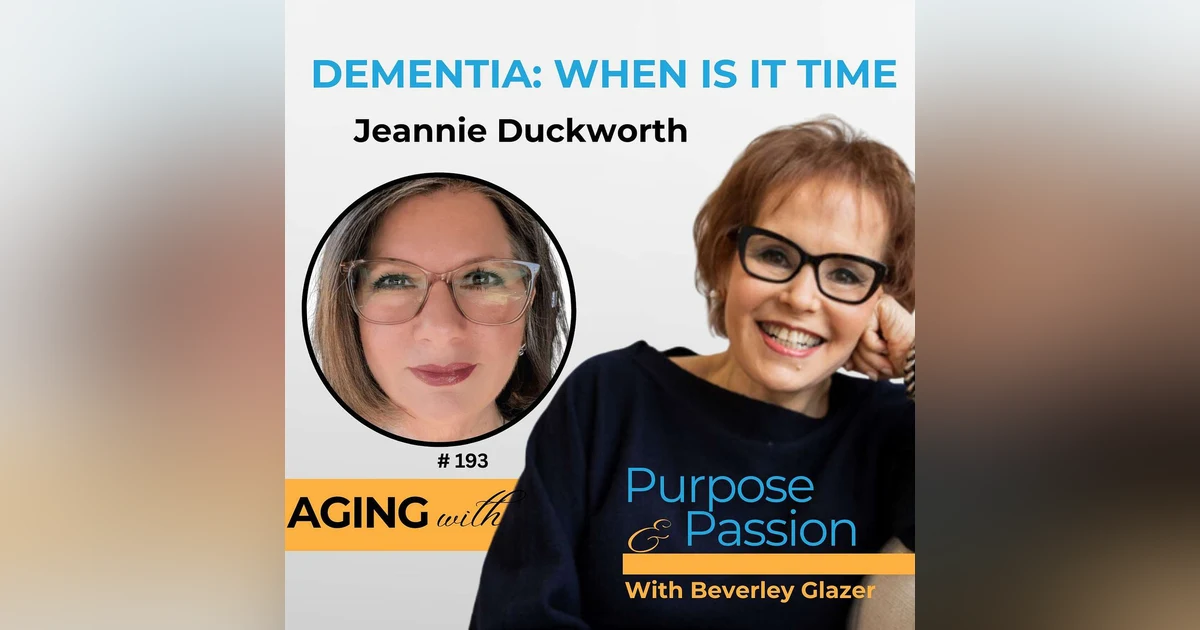


Jeannie Duckworth on caregiver guilt, dementia warning signs, memory care, senior living, and making difficult decisions before a crisis forces them.
How do you know when keeping an aging parent at home is no longer the safest—or most loving—choice?
For many high achieving women, that question comes with enormous guilt.
You promised you'd be there. You want your parent to remain independent. And every new problem can seem manageable—until wandering, falls, medication mistakes, dementia, or caregiver exhaustion changes everything.
In this episode of Aging With Purpose and Passion, Beverley Glazer speaks with Jeannie Duckworth, founder and CEO of Blue Magnolia Senior Living Advisors, about one of the most difficult transitions families face: recognizing when an aging parent needs more care than the family can safely provide.
Jeannie has guided thousands of families through senior living decisions, but her understanding of caregiving also comes from personal experience with caregiving, loss, and rebuilding her own life.
Together, Beverley and Jeannie explore the early signs of dementia families often explain away, what can signal that living at home is becoming unsafe, and why moving someone into memory care does not necessarily mean you've abandoned them. Sometimes a specialized setting can provide attention, structure, safety, and support that even the most devoted family cannot provide around the clock.
They also discuss caregiver burnout and guilt, the differences between independent living, assisted living, board-and-care homes, and memory care, and why families are better served when these conversations happen before an emergency.
Jeannie shares practical areas to address early, including advance directives, medication lists, finances, CPR preferences, and—most importantly—what good care means to the person you love.
You'll also hear about caregiver support groups, Alzheimer's resources, and financial assistance that some families may qualify for, including Veterans Aid and Attendance depending on eligibility.
If you're caring for an aging parent while also managing your career, family, health, and your own future, this conversation is a reminder that needing help does not mean you stopped caring. The goal isn't to prove how much you can carry. It's to make the best decision you can for everyone involved.
Stay until the end, when Beverley shares key takeaways and practical actions you can begin using immediately.
In This Episode
- How to know when an aging parent may no longer be safe at home
- Early dementia signs families often overlook or explain away
- When it may be time to consider memory care
- How to manage caregiver guilt when a parent needs more help
- The difference between independent living, assisted living, and memory care
- How caregiver burnout affects families and decision-making
- Conversations to have with aging parents before a health crisis
- Advance directives, medications, finances, and end-of-life preferences
- Finding caregiver support and dementia resources
- How to plan a senior living transition before an emergency forces the decision.
🔗 Resources
For similar episodes on caregiving, check out this incredible story, Driving Miss Norma. That's episode 139. And from CEO to Caregiver, episode 152 of Aging with Purpose and Passion. And if you're going through difficult times with a loved one, the Dementia Decoded Podcast with Jennifer Fink is a masterclass for the working family caregiver. That's podcast.show/fading memories.
Jeannie Duckworth, CDP – Founder & CEO, Blue Magnolia Senior Living Advisors Inc.
🌐 Website: Blue Magnolia Senior Living Advisors
💼 LinkedIn: Jeannie Duckworth
📸 Instagram: @jeanniebluemagnolia
Beverley Glazer, MA, CCC – Life & Work Transition Coach | Reinvention Strategist | Host of Aging With Purpose and Passion
🌐 Website: ReinventImpossible.com
💼 LinkedIn: Beverley Glazer
📘 Facebook: Beverley Glazer
👩💼 Women Over 50 Rock! Community: Women Over 50 Rock!
📸 Instagram: @beverleyglazer_reinvention
🎁 The Gift of a Safe Space: A private, non-judgmental zone away from work and family to focus entirely on your needs, your journey and what's next for you. If you are feeling stuck in your transition, this is your space to exhale.
Have feedback or a powerful story that's worth telling? Contact us at info@Reinventimpossible.com
00:00 - Welcome And The Central Question
02:35 - Growing Up Around Seniors
04:32 - The Family Secret Comes Out
07:49 - Parenting A Child With ODD
10:09 - Early Dementia Signs And When Memory Care Is Needed
13:02 - Turning Caregiving Experience Into Blue Magnolia
14:55 - What Families Should Plan Before A Caregiving Crisis
16:50 - When Is It Time For Memory Care?
20:02 - Takeaways Resources And Next Steps
Welcome And The Central Question
AnnouncerWelcome to Aging with Purpose and Passion, the podcast designed to inspire your greatness and thrive through life. Get ready to conquer your fears. Here's your host, psychotherapist, coach, and empowerment expert, Beverly Glazer.
Beverley GlazerHow do you know when keeping someone home is no longer the loving thing to do? Welcome to Aging with Purpose and Passion. I'm Beverly Glazer, a life and work transition coach and reinvention strategist for women over 50, helping you bridge the gap between the life you've built and the life you're ready to live next. And you can find me and this podcast at reInventimpossible.com. These conversations share powerful stories from accomplished women who face life's toughest transitions and use their wisdom, resilience, and lived experience to create meaningful new lives. We don't sugarcoat our struggles here. We learn from them, grow through them, and discover what's possible on the other side. My guest today is Jeannie Duckworth, founder and CEO of Blue Magnolia Senior Living Advisors. Jeannie has helped thousands of families find the right care for an aging parent or loved one, but her compassion did not come from a textbook. It grew from her own family's story of dementia, caregiving, loss, reinvention, and discovering that sometimes the most loving decision is also the hardest one to make. So if you're caring for an aging parent or carrying the weight of making difficult family decisions, this conversation is for you. And stay with us until the end, and I'll share key takeaways and simple actions that you can begin using right away for yourself, too. And if you're thinking that's me, well then let's have a conversation about what's next for you. You'll find that link in the show notes. So welcome, Jeannie. Welcome. Thank you. Jeannie,
Growing Up Around Seniors
Beverley Glazertake us back. What was your childhood like?
Jeanie DuckworthOh well, I grew up in California in a little town that's not so little anymore called Hayward. Um grew up with my mom and um my stepdad, who I call dad. And I had a brother um who was nine years younger than me, and another brother that we don't necessarily have anything to do with anymore. Um, but uh just grew up in a small town, grew up uh in my mom's dog grooming salon that my grandmother started in the late 40s. And believe it or not, I I had my first customers at the age of four. So I was grooming dogs at four years old until about 40, 42 when I developed arthritis. Uh and yeah, that's that's how my childhood was. I grew up riding motorcycles and horses and just uh living the good life. We lived in the country part of Hayward, so it was unincorporated at the time.
Beverley GlazerSounds wonderful. Fantasy.
Jeanie DuckworthGreat. It was like um uh Mayberry. So, you know, uh we knew everybody, and I could ride my horse to elementary school, and I walked to high school and all of that. So it was quite great. It's not like that anymore, but it was quite great, great back then.
Beverley GlazerYeah. But you also mentioned that you um liked hanging out with the adults and not so much with the kids.
Jeanie DuckworthI did. Um, my mom used to show cats uh professionally, so she she raised Persians and exotic short hairs. And um, ever since I was little, that she would she still tell of stories where if there was a room full of children or a room full of adults, uh seniors, which room I would go hang out with, and that was seniors every single time I would sit on their laps and listen to their stories for hours. Like it was my favorite, still is to this day my favorite thing to do.
Beverley GlazerAnd
The Family Secret Comes Out
Beverley Glazeryou somehow knew that there was a big family secret. How did how did you, you know, know that something was not being told?
Jeanie DuckworthOh well, it I um I had a stepdad and I knew my dad had died. Um, and I was not allowed to meet my uh birth father's family. Um, and over the years it took some time, but eventually I found out that my dad was an escapee from the Oklahoma penitentiary. He had gone AWOL from the Army during Vietnam and um or Korea, I don't know which one, um, because I I was two years old, almost three, when he died. Um, and he came to California and married my mom underneath an alias. Oh goodness. He died in a car accident. And uh the FBI came knocking on my mom's door and said, by the way, um if you allow your children, because it was myself and my uh one brother that we don't have anything to do with uh at the time, because he was just about two or three weeks old, if if you have contact with the family, then we know you knew he was an escape convent and we will charge you. So I didn't get to meet my family or speak with them until I was a little over 18. And I'm just now meeting them. I did meet a long-lost brother that my dad had, uh, and his name was coincidentally the same name as my father, Rodney Glenn Hughes. And I met him, oh gosh, 15 years ago, 16 years ago. There was a glitch on Facebook, and I happened to Google uh or Facebook, Rodney Glenn Hughes Jr. and popped a picture that looked like my dad, my birth father, but I didn't know it. Um, and I just sent a quick message, no phone number, nothing to this gentleman. And the pictures I had of my birth father were side profiles. There was never any front-on pictures of him. So I messaged this guy and I get a call at midnight, and he goes, I'm your brother. And I don't even know how we got my phone number. Like he called me, he called my mom, he called my dog grooming business at the time. And it turned out he was my brother. Um, and then he died uh about six years after we met. He had a heart attack. So my goodness.
Beverley GlazerMy goodness. And you kept on searching.
Jeanie DuckworthI kept yeah, I found um a couple of cousins and some aunts. Um, I actually got to meet my one cousin, um, Shannon in Texas about seven years ago. She was very sweet. It was weird to see somebody that has the same mannerisms that you have. Um, again, uh the only person I ever knew was my mom, my brother, and my my now stepdad, dad, um, who's my whole world. I love my dad. Um, and I met Shannon about seven years ago. And then last year I got to meet another cousin. Her name is Jennifer, and I got to meet her in Tennessee. So it was quite nice. Uh, but she's very tall. I'm very short. I'm five foot one.
Beverley GlazerSo
Parenting A Child With ODD
Beverley Glazeryou had a career. You had to step away from that career career to raise your son. Yes, who had special needs. And that was a huge decision, I'm sure.
Jeanie DuckworthThat was actually um when I got pregnant with him, I was a high-risk pregnancy. I almost died with him. Um, I had to have a nurse come to the house to give me a vitamin B shot and um uh an IV um every other day, uh, because I I just I had that weird thing where you throw up constantly. Like I couldn't even hold down uh water. Um my husband and dad said, well, I couldn't hold down air. So um, and when he was born, uh, brilliant, brilliant, brilliant, he's brilliant, he's beyond brilliant, um, but he had ODD and OCD, oppositional defiant disorder and um obsessive compulsive disorder. Um, and then right after him, uh about 10 months later, we had James, uh, who was completely normal. But Matthew, when he was growing up, um he just he couldn't be raised like normal children. He he um would punch holes in the walls and and and he was very uncontrollable. He's great now, but when he was a child child, it was very hard. And and school meetings and it just took up my whole day every day.
Beverley GlazerYes. And so you really had to change. Yes, your whole life had to change. How were you able to balance that? Because now you had two little children, and one was very, very difficult.
Jeanie DuckworthIt oh gosh, how did I balance it? I have no idea how I balanced it. My husband was working full time and going to school full-time, and then at the time, um, because we needed extra funding, um, I went to work at my mom's dog rooming salon uh again instead of just being at home. So whenever I had when my husband would be home, I would go to the salon to work to be able to um get some child's care care. So we went to a preschool. Um, and he needed to go to a preschool so I could have some sanity. Uh so he went to preschool at around three. Uh, but yeah, yeah. Yeah, it's difficult. It's very difficult. He's great now, but uh he's not known most of it.
Beverley GlazerGreat.
Early Dementia Signs And When Memory Care Is Needed
Beverley GlazerYour grandmother she had dementia.
Jeanie DuckworthYes.
Beverley GlazerHow did you discover that? What was going on?
Jeanie DuckworthUm it was just little things. Um, when we had phone conversations, she was living in Oregon at the time, so we had phone conversations and things just seemed off at the time. Oh, we're gonna go adopt somebody. I'm like, but grandma, you're like almost 80. Why are you gonna go adopt somebody? Um, and I was her favorite. Uh so uh she eventually came to live with my mom because she had a husband that was not so nice to her. Um, so she came to live with my mom, and she lived with her for a couple of years. And um, I had my last baby, Luke, and he uh is nine years younger than my other ones. And she was in the house one day with the walker and she kept calling him that thing. I didn't know anything about dementia, nothing. And she went to slam her walker down on him. And yeah, um, she missed him because luckily he was a newborn and hit the walker height and all of that. So um my aunt and uncle came from Oregon and said, we'll give you a respite, you and your mom a respite. Um, in turn, they moved her into memory care, and it was the best thing that they did. When she was living with my mom, it was hard because it wasn't focused about her. We were still a family, we were still going about our days, going and doing this, and she needed it the focus to be on her. And you know, uh, so that's that's how that happened.
Beverley GlazerYes. Many women are caregivers and they're also still working. You had some very difficult experiences doing all that. What would you tell them that you would have liked to have known sooner?
Jeanie DuckworthI wish that I had known that there was support groups. I wish that I had known that there was resources available, um, such as through the Alzheimer's Association, uh, the support groups that can tell me what's going on with my grandmother. Uh, she was a machinist during World War II. So she was one of the Rosie the Riveters, but not an actual, she wasn't Rosie the Riveter, but she was one of them. And I, if I had known now, if I had known then what I know now, I could have gotten her veterans aid in attendance to help pay for things and some other things. Um, but I didn't know about those resources at the time. So uh, but she when she moved to Oregon, uh, she was able to live in a Medicaid community and she lived there for eight years. Oh she did quite well. She did quite well. She still knew my voice on the phone, but she didn't know who I was.
Turning Caregiving Experience Into Blue Magnolia
Beverley GlazerWhy did you start your company? Tell us about it.
Jeanie DuckworthUm, I started my company. I used to work for a very large national placement and referral company. I was their healthcare account executive, and I was going into the hospitals and rehabs and dealing with the case managers and finding patients that needed um a higher level of care. And I kind of noticed that there was a little bit of a disconnect. We were only referring out the patients that can afford things. We weren't taking care of everybody. And I noticed that um the amount of places that we could refer to at the time in California through the company I worked for did not equal the amount of communities that were actually available. They were falling short by about 5,000, 6,000 communities. So I had a long discussion with my husband. We were helping to raise my grandbaby, Aiden, who is seven years old. He's my middle son, James's son. And he was living here at the house with us, and my son um is a single dad. So I just wanted to be able to spend more time with him. I was working 24 hours a day, seven days a week during COVID and all of that. And I was with him for nine and a half years. I told my husband the grandbaby was moving to Tennessee. I need to go with him. Long story short, lots of prayers. We started our own agency. And it's actually named Blue Magnolia because blue is my grandson's favorite color. And magnolia is one of the oldest living uh flowering trees. And my girlfriend Christy had given us that uh last part was the magnolia. So it was kind of nice. But we started it so we can help all seniors that we could possibly help. And if we can't help them, we try to find the resources we can.
unknownYeah.
Beverley GlazerAnd you've helped thousands of families, Jean.
Jeanie DuckworthThousands over the years.
What Families Should Plan Before A Caregiving Crisis
Beverley GlazerYeah, yeah. What is one thing that they all have in common?
Jeanie DuckworthThey didn't plan. Most of them didn't plan. They didn't have the conversation with their adult children. They didn't plan for uh the next phase of what happens after retirement. Where do I, what is my care plan gonna look like? They didn't plan. Um, so that's the thing I see the most in common. Um, and they just they need help. They, you know, we were all stuck at home during COVID, right? And we were getting antsy in the four walls that we're in, but we don't realize that that's our loved ones every single day that are seniors. If they're not interacting with people on a normal basis, they're living through COVID every single day because they're in that realm of the four walls and nothing else going on. So um I believe that had they planned things and started looking earlier in their 50s and 60s, they would have known where they would know where to go in their 80s, 90s.
Beverley GlazerYeah. So you what you're doing is you're suggesting that the family has a conversation before it's even necessary.
Jeanie DuckworthYes. Oh, yes, definitely. I had this conversation with my parents daily. Um, hey, where's your advanced directive? I don't see it on the refrigerator. How come it's not on the refrigerator? What happens if you and dad fall at the ambulance needs to know what type of medications you on you're on? Um, do you want CPR? Do you want this? They so I have these conversations with my own parents on a regular basis, finances and all.
Beverley GlazerSo not to fear that conversation. Mm-hmm. Okay. And so what would you tell somebody who's looking for a placement, but they also feel extremely guilty?
Jeanie DuckworthWow.
When Is It Time For Memory Care?
Jeanie DuckworthDon't feel guilty because a lot of times the caregivers themselves are the ones that end up getting sick. Case in point, um, Gene Hackman, lovely man, beautiful man. Um, they got the Honta virus where the wife did, and she passed away and he was alone in his home, according to the news reports, for two weeks. That's two weeks with nobody cooking for him, nobody feeding him, all of that. So the caregivers a lot of times can become sick and when they're taken away, what happens to our loved one that was receiving the care? So I suggest that we start the conversations early so we know what the care plan is for them. Hopefully, I didn't go off tangent on that.
Beverley GlazerNo, no, you were right on
Jeanie DuckworthOkay.
Beverley GlazerWhat would you tell somebody that's looking for a place? Like, how do you know?
Jeanie DuckworthI would say reach out to your local resources. Talk to your case managers at the hospital, your discharge planners at the rehab. Um, look for referral agents in your area that can help walk you through the process. You want ones that uh take what they do very seriously. We're proud proud members of the National Placement and Referral Alliance. I'm also a certified dementia practitioner. So I think if families start the process early and start working with somebody that can take them on tours, even if they're not looking for 10 years down the road, at least if they're having the conversation and going and doing the tours now, they know what mom, dad, and uncle, grandma, grandpa want, um, as opposed to me getting a call from Kaiser Hospital saying, hey, this patient needs to be placed tomorrow. There's no time for me to search, right? I'm just doing the emergency placement versus, hey, they already know the type of community they want. It's all documented. They already know what their finances are in place. Um, and if they have that, it's an easier transition for their loved one. If it's blindsided, it makes it very rough. And sometimes it's not a successful placement.
Beverley GlazerLeave us with one last word of advice, Jeannie. What would you tell somebody listening that's going through this right now?
Jeanie DuckworthIt's okay. It's okay to reach out for help. It's okay to go in the bathroom and cry. It's okay to call a neighbor and say, hey, I need to go to the movies, or to call a home care agency and say, Hey, can you come watch mom three days a week for two hours at a time, four hours at a time? Um, because if you're not taking care of your own prioritizing your own health and your own needs, you're not going to be able to take care of your loved one. In a community setting, whether it's a board and care, assisted living, independent, or memory care, they have several employees that they can tap on the shoulder and say, Hey, you know, I've been with Mary for a few minutes. I need to step away. Can you now interact with Mary for a few minutes? At home, we don't have that. So it's okay to ask for help. It really is. Thank you.
Takeaways Resources And Next Steps
Beverley GlazerThank you, Jeannie. Jeannie Duckworth is the founder and CEO of Blue Magnolia Senior Living Advisors, where she helps families find the right senior living community for their loved ones. She was a successful entrepreneur and then arthritis forester to stop. But Jeannie reinvented herself to help others, drawing on her lifelong experience as an entrepreneur, caregiver, and an advocate who's helped thousands of families with compassion, practical guidance, and care. Here are some takeaways from this episode. Get the information you need before you're under pressure. Waiting too long can create more fear, guilt, and a crisis for everybody involved. And sometimes the most loving decision is also the hardest one to make. If you've been relating to this episode, here's what you can do for yourself right now, just as Jeannie said, don't wait for a crisis to happen. Start this conversation early and learn about the care options in your community so that you're prepared and reach out to professionals who can guide you through the options and the resources. For similar episodes on caregiving, check out this incredible story, Driving Miss Norma. That's episode 139. And from CEO to Caregiver, episode 152 of Aging with Purpose and Passion. And if you're going through difficult times with a loved one, the Dementia Decoded Podcast with Jennifer Fink is a masterclass for the working family caregiver. That's podcast.show fading memories. And so, Jeannie, where can people find you?
Jeanie DuckworthPlease share your links. Um, my uh web. Page is www.blue mag, which is short for magnolia, fla, which is short for singular living advisor.com. So www.bluemagfla.com or also on Facebook, and you can also call me anytime.
Beverley GlazerAnd they're on my site too. That's reInventimpossible.com. And tell my friends, what's next for you? If you're wondering what's possible for yourself too, let's map that out together. You'll find the link in the show notes on reinventimpossible.com. And if this conversation spoke to you, please. Share it with a friend who may need to hear it right now. And remember, you only have one life. So live it with her.
AnnouncerThank you for joining us. You can on our website, read impossible.com. And while you're there, join our newsletter. Subscribe so you don't miss an episode. Until next time, keep aging with purpose and passion. And celebrate life.