Reinvention After 50: Stop Proving Your Worth
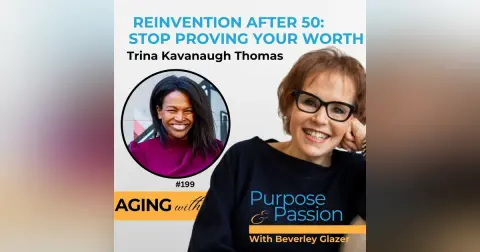


People pleasing, burnout, somatic leadership, nervous system regulation, and what changes when high-achieving women stop performing for approval.
You can spend years becoming the woman everyone admires—and quietly wonder how much of her is actually you.
For high-achieving women over 50, success can hide something uncomfortable: the habits that helped you achieve, belong, and earn approval may also have taught you to perform.
In this episode of Aging With Purpose and Passion, Beverley Glazer talks with Trina Kavanaugh Thomas, award-winning leadership coach and founder of the Somatic Leadership Group, about what happens when achievement, people pleasing, and the need to belong become so familiar that you don't realize you're wearing a mask.
Trina built a thriving fitness business and looked successful from the outside. Inside, she was exhausted and anxious. Beneath the achievement was an old feeling of not being chosen—and a pattern of seeking approval, attention, and belonging that followed her into adulthood.
We talk about why accomplished women can become exceptionally good at saying “I'm fine” when something is clearly missing, and how the need to prove your worth can show up in business, leadership, body image, relationships, and social media.
Trina also speaks candidly about sobriety and the small, steady decisions that began changing her relationship with herself.
But choosing yourself isn't about walking away from your responsibilities or putting yourself ahead of everyone else.
It's about noticing where you're performing instead of choosing.
That's where Trina's work in somatic leadership becomes practical. She explains how old emotional patterns can continue influencing the nervous system, why the body may react before the rational mind catches up, and how awareness can create space between an automatic response and a different choice.
We explore burnout recovery, nervous system regulation, imposter syndrome, people pleasing, boundaries, and what it means to stop organizing your life around other people's approval.
At some point, proving yourself stops being ambition.
It becomes a way of organizing your life around what other people think.
And after decades of being capable, productive, and dependable, that can leave you with a surprisingly difficult question:
If I stopped trying to prove who I am, what would I actually choose?
Stay until the end, when Beverley shares key takeaways and practical actions you can begin using immediately.
IN THIS EPISODE
- Why high-achieving women can still struggle with self-worth
- How people pleasing becomes a strategy for belonging
- What burnout can look like when you still appear successful
- Why “I'm fine” becomes a mask for capable women
- How to stop seeking approval and start trusting your own choices
- What somatic leadership means in everyday life
- How nervous system regulation affects stress and decision-making
- Why old emotional patterns can influence present behavior
- How sobriety changed Trina's relationship with herself
- Practical ways to set boundaries and stop proving your worth
For similar episodes on reinvention after success, check out Success, Burnout, and What Really Matters, that's episode 184. And your best work isn't over. That's episode 185 of Aging with Purpose and Passion.
Resources:
Trina Kavanaugh Thomas – Award-Winning Leadership Coach | Founder of Somatic Leadership Group
🌐 Website: personalenergywithtrina.com
📘 Facebook: facebook.com/trina.kavanaghthomas
💼 LinkedIn: linkedin.com/in/trinakavanaghthomas
Beverley Glazer, MA, CCC – Work and Life Transition Coach | Host of Aging With Purpose and Passion
🌐 Website: reinventimpossible.com
💼 LinkedIn: linkedin.com/in/beverleyglazer
📘 Facebook: facebook.com/beverley.glazer
👩💼 Women Over 50 Rock! Community: facebook.com/groups/womenover50rock
📸 Instagram: instagram.com/beverleyglazer_reinvention
🎁 The Gift of a Safe Space: A private, non-judgmental zone away from work and family to focus entirely on your needs, your journey and what's next for you. If you are feeling stuck in your transition, this is your space to exhale.
Have feedback or a powerful story that's worth telling? Contact us at info@Reinventimpossible.com
00:00 - Welcome And Guest Setup
02:30 - Where the Need to Belong Begins
05:40 - What “Not Feeling Chosen” Does to You
10:20 - Finding Fitness Through Zumba
15:40 - The Mask Of Being Likeable
22:00 - Quitting Drinking And Choosing Yourself
28:40 - When High Achievers Say “I’m Fine”
32:00 - How Your Nervous System Keeps Old Patterns Going
34:55 - How to Stop Proving Your Worth
Welcome And Guest Setup
SpeakerWelcome to Aging with Purpose and Passion, the podcast for women over 50 and beyond who know much more lies ahead of them. Listen to real stories, hard truths, and life-changing choices that may leave you seeing your own life a little differently. Here's your host, work and life transition coach, Beverly Glazer.
Beverley GlazerWho are you when you're not the one that everyone relies on? Welcome to Aging with Purpose and Passion. I'm Beverly Glazer, a life and work transition coach and reinvention strategist for women over 50 helping you bridge the gap between the life you've built and the life you're ready to live next. And you can find me and this podcast at reInventimpossible.com. These conversations share powerful stories from accomplished women who face challenges and use their wisdom, resilience, and experience to create meaningful new chapters. We don't sugarcoat our struggles here. We learn from them, grow through them, and discover what's possible on the other side. Today I'm joined by Trina Kavanaugh Thomas. Trina is an award-winning leadership coach and the founder of the Somatic Leadership Group. For many years, Trina looked successful in the eyes of everyone else, but behind the scenes, she was exhausted and living behind a mask she didn't even know she was wearing. Today, she helps successful women reconnect with their authenticity and lead with their inner truth. If you've ever felt lost between your roles, your responsibilities, and other people's expectations, this conversation is for you. And stay with us until the end, and I'll share key takeaways and simple actions that you could do for yourself right away. And while you're listening, when you find yourself thinking, hey, that's me too, then let's have a conversation for what's next for you. You'll find that link in the show notes as well. So welcome, Trina. Welcome.
Trina Kavanaugh-ThomasHello, it's really great to be here.
Where the Need to Belong Begins
Beverley GlazerTrina, let's go back. Looking back when you were just a child in your family of origin, what was it like growing up for you?
Trina Kavanaugh-ThomasUm for me, I think looking back, for me it was good. And I think that's because I've done a lot of work on it. So I see it as like a different thing now. For me, it was really good.
Beverley GlazerI think as I grew up though, and maybe if you asked me maybe about um a few years ago or something, I would have said it wasn't as good as true because we change, you know, we change and our perceptions change, and as we work on ourselves more and more, our lives get lighter and we start feeling better. But we are who we are because of those miseries, if you will.
Trina Kavanaugh-ThomasAbsolutely, absolutely. You know, when I was a when I was a child, you know, we used to here in the UK, we used to, you know, go to a pub or something like that. I used to go to a pub with my family. My granddad used to play in a band, is I he is Irish, so he used to play in a band, everyone used to smoke in the pub. Um, my mum would smoke, my granddad would smoke, my grandma smoked, everyone in our whole family smoked, and then obviously I'm sat in a pub at the age of maybe five, um, and everyone's smoking around us and stuff, and obviously drinking and having a good time, um, which is obviously classed as you know what I saw at the time was fun and relaxation. So um, but you know, I know now that they really deeply loved me, but they couldn't get out of some of the behaviours that you know they were going through. And as a child, you know, um, with that amount of smoke, by the end by the age of ten, um, the doctors thought that I actually actively smoked.
Beverley GlazerReally?
Trina Kavanaugh-ThomasYes
Beverley GlazerMy goodness.
Trina Kavanaugh-ThomasWhich I didn't.
Beverley GlazerAnd and you said that you never felt you were chosen. What do you mean by chosen?
Trina Kavanaugh-ThomasUm I think for me through life. I think this is definitely something that I've worked on because as soon as you've asked me about it, I'm kind of like, oh I can't, you know, like where you can't think about it. You know, right, right. Yeah, so um I suppose it's being chosen to belong in certain places, maybe at school and things like that, in different groups, um in different dynamics. I mean, if I really think back, um I grew up, I grew up in a my mum's mixed race. Um, my I'm mixed race too. I didn't grow up with my dad. I grew up in an Irish, British household, um, which was really beautiful, you know, and I'm really lucky. I'm really lucky because I learned to be an opportunist at such a you know, at such a young age because my
What “Not Feeling Chosen” Does to You
Trina Kavanaugh-Thomasgranddaugh was an opportunist. But um, I suppose going to school, um I wasn't chosen by by people with the same color as me. So I wasn't fully chosen, you know, so um that's what I felt like at school, right? But but I suppose it set me on the trajectory that I'm on already.
Beverley GlazerOf course, of course. But what happens is you overcompensate for that, you know, it's like if I'm not good enough, you can go one way, you can go the other way. But whatever it is, is I can also prove myself, and you did that. You had a successful fitness business, yeah, and you really built that up. Why did fitness call you? What were you good in sports? Like, what was that kid that said, ah, I have to follow that rogue?
Trina Kavanaugh-ThomasNo, it was rubbish at sport. I was I was absolutely I was rubbish at sport, and uh um when I got to the age of I loved dancing, so so I absolutely adored dancing ever since I was a kid. I also loved and was a little bit infatuated in like medical journals and stuff from when I was a kid as well, and I would also equally draw from those medical journals as well a lot of artwork, you know, like drawing like diagrams and all those kind of things. So when I got to the age of 16, I was looking for like a job. Um, I didn't know what I wanted, I kind of wanted to become a doctor, but I didn't have the grades to do so. Um, but then I ended up going into dentistry, and then I actually got a um went to college to go and do a uh a gym instructor course, um but I felt like it was too competitive, so I stepped away, went into hairdressing for quite a long time, then went into customer services, and then by the time I got to about 30, I didn't really like customer services anymore, and that led to the fitness stuff. So I actually walked out of my job of customer services and then went into doing Zumba because that's when Zumbrood more or less about a couple of years after Zumbra had started, was coming to the UK, right? And it was like dancing and fitness, and I've like lost some weight and stuff, so it was almost like that role that I was gonna go for at the age of 16, that refound me at the age of 30. Right, and and that led into like a really nice career do and it was my own, it was my own little business that I created in in the fitness world.
Beverley GlazerYes, and if fitness was like it was in North America, it was rage. People went into Zumba, it was fun, and anyone could do it. And and you know, so it was fitness, it was music, it was athleticism, it was a heck of a lot of fun.
Trina Kavanaugh-ThomasYeah, yeah, it was it was fun, as you say, it was fun, it was like really sweaty, it was it was great, you know, and I I had a really good time. I had a you know, I had a really good time, and yeah, um, as you know already, you know, it sets us on a co it's it's just all part of the journey of where we're getting.
Beverley GlazerYes, but you said that you wore a mask, like you were good at what you did, you had clients, you built your business, you already had this entrepreneurial spirit, you were in a hairdresser, you did numerous things, and now you know, now you have you have your company, you have a fitness business that was thriving. And so, how did you feel you had a mask?
Trina Kavanaugh-ThomasUm, I think for me, uh I mean, if I really look back over my videos and things, it was like, hey guys, it's Trina here. It was almost like a kind of exaggerated persona with me. And um it was almost like you know, I had to be everyone's friend, I had to know everyone, I had to share everything about myself with everyone, I had to be like that, you know, to
Finding Fitness Through Zumba
Trina Kavanaugh-Thomasto belong, to yeah, to meet people, you know, to be accepted by people, and that you always feel something different when you've got that mask as well, and not only that, for a while I was really super fit, and then I had a baby, and it took me a while to lose to lose that weight, but then I became accepted for having more weight on me, so I became accepted for having weight, but in the background, while I joined body positivity movements and all those kind of things, in the background, while I was championing on, there was a part of me that was kind of like I really want to lose this weight, and and I didn't realize how much the work is in like being anxious or being overweight had me kind of like thinking, or and drinking as well, had me kind of not wanting to let go of those things because then you let go of you let go of the people who value for those things.
Beverley GlazerSure, sure. And I've spoken to many influencers as well that had that same experience, or people, even in corporate in the corporate world, particularly, and I should say that, um, who are extremely successful and they talk in public and they've had the training and they're able to do it all. But inside there's that little imposter feeling, the feeling that, yeah, I'm good at that, but I'm not as good as I should be. Uh, I really should be something else. And that's a very uncomfortable feeling to have. And so when you're out there, when you're out there pushing your business and thinking, yeah, but I'm not really accepting myself, it's very hard to work with people as well. There's a conflict. Did you feel that that was a conflict for you back and forth, or did you just kind of ignore it?
Trina Kavanaugh-ThomasUm, I in some parts I would definitely ignore it. And I think that was because, and not only that, I would always be um triggered by certain things. So if someone said something, it would really upset me in some way. Um whereas now I can now look back and see, oh, the reason why I was upset was the fact that you know that I was I was playing a character and I didn't want to play that character anymore. You know, I was you know, when um TikTok first came out, you know, obviously on Facebook and stuff like that, it was almost like you know, I had to feel like I had to shake my booty and all those kind of things. It's okay when I was in a fitness session because that's that's part and parcel of like and that's the funness of it, right? Yeah, but but when I was like, you know, trying to gain more viewers or trying to bring more people in, than having to be that kind of performative person, and I it just wasn't me. Yeah, and and you know, when you leave that behind, you you get all these thoughts and feelings in your mind at the time that you still want to be that performative person, which is you know, because it's familiar, and you don't know who you are, yeah, yeah, absolutely, absolutely, yeah.
Beverley GlazerYeah, and so you experienced stress and health issues and drinking, and eventually you closed your business, and that must have been extremely difficult too because now, just as I said, you don't know who you are, yeah, and so that's when you really have to work on yourself. Who am I? And you came out with choosing myself, yeah. Talk about that.
Trina Kavanaugh-ThomasSo um, I suppose for me and this is literally coming up to the seventh year of stopping drinking as well, and it did from when I let go of the business, um, which would have been about 2018, and that side of the business, um, it took me a few years to get to the point where I sat in the bath one night and thought, Who am I? And that's when I was kind of like, oh, I don't even actually know who the hell am I, and that then was a journey of a learning of when I'm being someone else and not myself, and abandoning myself and not choosing myself. So for me, choosing myself is coming like it it wasn't like a massive thing, it was one decision to another decision, if that makes sense. And when when I stopped drinking, that was a decision for me, and every day after that became a decision for me, and now I'm at a
The Mask Of Being Likeable
Trina Kavanaugh-Thomaspoint where I would never drink again, and I don't, and I can still, I mean, like I love music, so I love like clubbing and all those kind of things, and I still can walk, I can walk, I'm really lucky because I can walk into a bar and not want to drink alcohol or anything like that. I can just have a dance and and get a water if I wanted to, you know, and just really enjoy the nightlife and and enjoy the um I want to say camaraderie. Um but it is, yeah, right. So so yeah, just enjoying that and and being home at an early, you know, an early time. And not only that, not being the last one there as well. We also had a FOMO where I had to be the last one there, and that also transpired in investing in things as well, you know, the FOMO of you know, not buying that program, not investing in that thing, not getting that thing, you know, because everyone else is doing it and it's so amazing, or just want to be in proximity with all these people and and all those kind of things. And over the over the years, I've learned when FOMO kicks in that I don't need to be in a room because someone's in there, because sometimes I can be in the room for the wrong reason, and and learning that I don't need to fawn all over people to you know to get what I want or um to be accepted by anyone, and that's taken that's taken a lot.
Beverley GlazerSo what you did was you stopped being a pleaser.
Trina Kavanaugh-ThomasYeah. Why do you think that so many women are that belonging connection wanting to be heard, wanting to be seen, not fully being seen by themselves, not being able to sit with themselves and that and you know, and you've probably seen this as well, that can sometimes take time, and giving yourself time to sit with yourself, not five minutes here, you know, like kind of oh let me just do this for five minutes or something, you know, or looking for the quick, quick, quick answer. Sometimes you have to spend time sat with this, and I'll be really honest with you, like even at this weekend, I sat in my hammock for four to five hours through boredom, through physical boredom. My body was like shaking and convulsing. It was because I wasn't used to that feeling of being bored, you know, not always having to um use something to soothe something, if that makes sense.
Beverley GlazerNo, no, it makes a lot of sense, particularly today in the world we live in, where we're always connected, never bored, there's always something to do, and there's nothing wrong with just chilling and allowing yourself to think. And you're known, Trina, for somebody that can just cut to the chase. And you work with high-achieving women who often just say, Oh, I'm fine, I have no problems, everything is fine. What do you notice that they don't see?
Trina Kavanaugh-ThomasSo the thing that they don't because they're not struggling. Oh, it's fine. Yeah, but they're they're not struggling at all. I notice the things that where they need support but are not letting support in. Um I also notice the it's cliche, isn't it? The the th is it a cliche? But the things that they can't see. You know, like sometimes they get like a feeling about a few things, and I notice the things that they they want to see, but they can't see, can't quite see, or don't want to really see. Um but usually it always comes down to a level of support um that they're missing. Time is a big one, it is having the time, having the space and having the energy, and usually when a lot of these women are already on a journey, so it's about maintaining the journey, and then when you maintain the journey, you're able to expand and have the capacity that you want, but that takes a bit of time, a bit of space, and then it builds that personal energy that people are looking for.
Beverley GlazerRight. What would you tell someone who is absolutely successful, much like you were, but they feel that something is missing, and they're successful, so it's like saying, you know, like how can anything be wrong? I'm fine. Well, we're back to the fine, right?
Trina Kavanaugh-ThomasYeah, but sometimes fine is a good thing as well. Yeah, sometimes fine can be it's okay because there's nothing going on right now, and you don't need to create anything extra, right? You know, but there is that feeling though, is I'm fine, but something then that that's the time to like be with yourself because I I personally believe that you're not disconnected. Exactly. I just think that you're just looking outside of yourself for a moment and you need to come back to yourself. Yes, and come back to yourself. And I think like people need the space to do that. And and not a space where it's kind of like in and out. I believe that people need a space where they can kind of explore what's going on and learn to let go of it themselves.
Beverley GlazerYes, and that's when we're talking about the bodywork. Yeah when you were talking about just lying there.
Quitting Drinking And Choosing Yourself
Beverley GlazerWhat is my body saying? And you do a lot about nervous system regulation. So explain that to someone who's listening like and says, What is that?
Trina Kavanaugh-ThomasYeah, no worries. So um, our our bodies is one, right? So we've got our mindset, which a lot of people work on, you know, mindset and things like that. But what we don't realize is what the mind is connected to, the brain is connected to, and it is connected to your body, and it is functioning your immune system, functioning your hormone system, functioning your breathing, your heart rate, and the rest of it as well. So it does all those things. Now we have an area of the brain called the amygdala, and the amygdala is our emotional memory center, and our emotional memory center has all those memories that kind of crop to the surface when something goes on, when we feel that imposter syndrome, or we want support, but we don't know how to say it, or we want more time, or we want the space, and even though we feel like we're getting those things, or we should be grateful for what we've got, we still don't feel like it because there's something running the show in the background, and what needs to happen is that they can be changed, those memories can be changed, you know. As I said right at the beginning, you know, when you Beverly asked me about my um my childhood, you know, I can't see certain things about my childhood anymore because these are the things that I'd been working on in my amygdala, that would then have my nervous system react very differently, my emotions be very different. So no longer would my hormones be, you know, um dysregulated, let's just say, all over the place. No longer will my breathing kind of start to get faster or my heart rate, you know, heighten. And sometimes that adrenaline is in our successes as well. So you've got to the point within your success, and really you do not need to operate like that anymore. That's not a way you need to operate any, and even though what our amygdala can do, it can work with our RAS reticular activating system. That's another area of the brain that's almost like a Google search that will search for the things based on your memories and what you're thinking and feeling in your body. So if you're thinking heightened stress, and I'm always stressed, and this is the way we do things to achieve things, and trust me, I know it because I was literally training like an athlete. You will meet the same people doing the same thing, and you will look up to them as an influence to you, and they will be as wealthy and have everything just like you, but they will literally um mold that story and keep that story going. So when you look at someone else who's not doing it that way, when you look at someone else who's doing it via ease, that it can be easy, it doesn't have to be so hard that you can take your time out, you can be present, then you are going to not want to do that. And also equally, you wanna you're gonna want to sabotage that now. If you change those memories, you're not gonna want to sabotage that, but you also equally, once you do that, you want to maintain it as well. You want to know where your where the continual blind spots are and stuff, because sometimes you know, even I can't see what I can't see, right? I can't always see what I you know what I can't see, but also equally I don't want to beat myself up if I can't see it neither. I don't think that's worth it. So I hope that's explained a little bit of yeah, certainly explained it to me.
Beverley GlazerI hope with people listening, I'd explained as well. And one last word, Trina, what would you tell someone who is listening right now to your journey and not only to your journey, but what they can do for themselves so that they can feel authentic in themselves and stop pleasing.
Trina Kavanaugh-ThomasHeaven is here on earth right now. It doesn't matter if you fluff up or you forget, or you know, you do things differently, it doesn't really matter. You know, you get one life, it's not in a past life, I'm afraid. And as much as you can go back to past lives, and as much as you can go back to these memories, like the life that you have is right now. And and I do feel like it's vitally important that you get to live your life now, even with all the successes that you have, that you get to live your life and not through someone else.
Beverley GlazerTerrific. Thank you. Trina Kavanaugh Thomas is an award-winning leadership coach and mentor and founder of Somatic Leadership Group. For more than 20 years, she's helped leaders, entrepreneurs, and high-achieving women break free from burnout, self-doubt, and the pressure to keep performing so they can lead with a greater authenticity, confidence, and purpose. Here are a few takeaways from this episode. You don't need to prove your worth by pleasing anyone else. Your body often tells the truth before your mind is ready to hear it. And the strongest leaders lead from truth, not from performance. If you've been relating to this episode, here are some things that you could do for yourself right now. Identify one mask that you've been wearing and gradually take it off. Allow yourself to say no to someone else so you don't have to compromise yourself and replace when I should. What this is what I choose to do. For similar episodes on reinvention after success, check out Success, Burnout, and What Really Matters, that's episode 184. And your best work isn't over. That's episode 185 of Aging with Purpose and Passion. And if you're going through some difficult times right now, Dementia Decoded Podcast with Jennifer Fink is a masterclass for the working family
When High Achievers Say “I’m Fine”
Beverley Glazercaregiver. That podcast is podcast.show fading memories. And so, Trina, where can people find you? Please share your links.
Trina Kavanaugh-ThomasOkay, you can find me on LinkedIn and you can also find me on Facebook as well.
Beverley GlazerTerrific. All Trina's links are in the show notes and they're on my site too. That's reinventedpossible.com. And so, my friends, what's next for you? If you're wondering what's possible for yourself too, let's map that out together. You'll find the link in the show notes and also on reinventimpossible.com. And if this conversation spoke to you, please add us to your playlist, share it with a friend who may need it right now, and remember, you only have one life, so live it with purpose and passion.
SpeakerYou've been listening to Aging with Purpose and Passion with Beverley Glazer. For more conversations and to explore Beverley's work, visit reInventimpossible.com. This story ends here. Yours may just be beginning.