Reinvention After 50: When Your Success Defines You
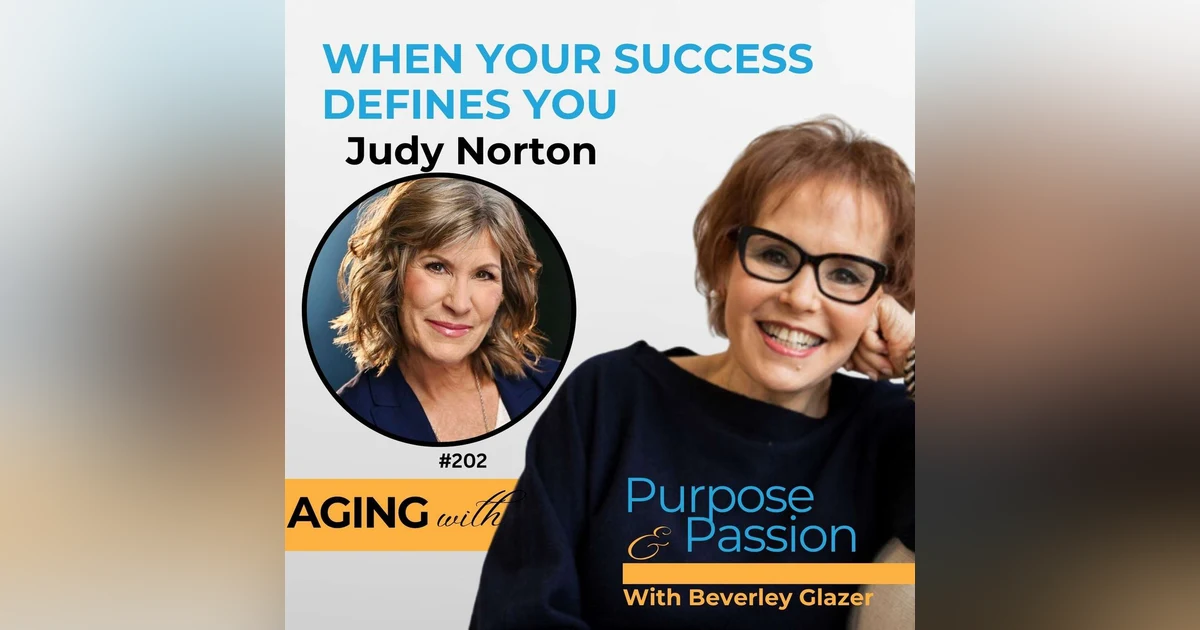
What happens when the role that made you successful becomes the very thing you can't escape? For nine years, Judy Norton was Mary Ellen Walton on the Emmy Award-winning television series The Waltons. Millions of viewers welcomed her into their homes. But when the series ended, the character people loved didn't simply disappear. And neither did their expectations of who Judy should be. In this episode of Aging With Purpose and Passion, Beverley Glazer, MA, CCC, ICF, a work and life transition ...


What happens when the role that made you successful becomes the very thing you can't escape?
For nine years, Judy Norton was Mary Ellen Walton on the Emmy Award-winning television series The Waltons. Millions of viewers welcomed her into their homes. But when the series ended, the character people loved didn't simply disappear.
And neither did their expectations of who Judy should be.
In this episode of Aging With Purpose and Passion, Beverley Glazer, MA, CCC, ICF, a work and life transition coach for accomplished women over 50, talks with Judy Norton about life after The Waltons, Hollywood typecasting, career reinvention, and what happens to your sense of identity when the world keeps defining you by your past.
How do you move forward when people refuse to see you differently?
Judy shares the uncertainty of building a career beyond a defining role, the challenge of rebuilding confidence when opportunities are limited, and how she continued creating through theater, music, writing, and directing.
She also talks about the personal work she did to understand herself beyond Mary Ellen Walton, including her experience with Dianetics.
And when COVID disrupted familiar ways of working, Judy found herself learning something she hadn't expected: digital marketing. That led to building a YouTube channel and connecting with an audience in a different way.
But this conversation reaches far beyond Hollywood.
Because what Judy experienced is something many accomplished women over 50 recognize.
You leave a career, but people still see your former title.
Your children grow up, but everyone still expects you to be the person who takes care of everything.
You change what you want from life, but the people around you are more comfortable with who you've always been.
Sometimes the hardest part of reinvention isn't changing your life. It's allowing yourself to change when everyone else expects you to stay the same.
Whether you're navigating a career transition after 50, questioning your professional identity, or wondering who you are beyond the roles that once defined you, Judy's story raises a question that deserves more than an easy answer.
Are you holding on to who you used to be—or are you afraid of disappointing the people who still need you to be that person?
Stay until the end for Beverley's key takeaways and practical actions to help you recognize what's changing in your own life and decide what comes next.
For similar episodes on Aging with Purpose and Passion, check out Who Are You Without the Career. That's episode 181. And episode 200, Life After Loss, Who Are You Now? And if you like podcasts for older women, Reinvention Rebels shares stories of unapologetic women from 50 to 90 who have reimagined life on their own terms. That's reinventionrebels.com.
Resources
Judy Norton – Actress, Singer, Writer & Director | Mary Ellen Walton on The Waltons
🌐 Website: https://www.judynorton.com
✉️ Email: judynorton@mac.com
📸 Instagram: @officialjudynorton
Beverley Glazer, MA, CCC – Work and Life Transition Coach | Host of Aging With Purpose and Passion
🌐 Website: https://reinventimpossible.com
💼 LinkedIn: https://linkedin.com/in/beverleyglazer
📘 Facebook: https://facebook.com/beverley.glazer
👩💼 Women Over 50 Rock! Community: https://facebook.com/groups/womenover50rock
📸 Instagram: @beverleyglazer_reinvention
🎁 The Gift of a Safe Space: A private, non-judgmental zone away from work and family to focus entirely on your needs, your journey and what's next for you. If you are feeling stuck in your transition, this is your space to exhale.
Have feedback or a powerful story that's worth telling? Contact us at info@Reinventimpossible.com
00:00 - The Question That Changes How You See Yourself
02:05 - How Judy Norton Got Her Start in Show Business
04:40 - Acrobat Roots and Athletic Confidence
08:00 - Judy Norton on Life Inside The Waltons
10:00 - After The Waltons: Hollywood Typecasting
13:20 - Identity and Confidence After The Waltons
18:05 - Career Reinvention Beyond Television
19:50 - From COVID to a YouTube Community
23:00 - Judy Norton's Advice on Trying Something New
26:40 - Takeaways and Where to Find Judy
The Question That Changes How You See Yourself
AnnouncerWelcome to Aging with Purpose and Passion, the podcast for women over 50 and beyond who know much more lies ahead of them. Listen to real stories, hard truths, and life-changing choices that may leave you seeing your own life a little differently. Here's your host, work and life transition coach, Beverly Glazer.
Beverley GlazerWho are you when everyone knows you for who you used to be? Welcome to Aging with Purpose and Passion. I'm Beverly Glazer, a work and life transition coach for accomplished women over 50 to achieve what they want from their career and their life. And you can find me at reinventimpossible.com. These conversations go beyond inspiring stories. They're about the moments that make you stop, question what you knew, and make hard choices to move forward. We don't sugarcoat anything here. We talk about the challenges, what it took to move through them, and what became possible on the other side. And today, I want you to meet someone you probably think you already know. She's Judy Norton from the Emmy Award-winning series The Waltons. She became known around the world as Mary Ellen Walton, the strong-willed eldest daughter of The Waltons. Judy is an actress, a writer, a director, a musician, and creator who has spent decades finding new ways to do the work that she loves. And that's what we're going to be talking about today. If you've ever wondered who you are without the title or the role that you've been known for, this conversation is for you. And stay with us till the end for some quick takeaways and actions that you could do for yourself right now. So welcome, Judy. Welcome. Thank you.
How Judy Norton Got Her Start in Show Business
Beverley GlazerHappy to be here. Judy, you grew up in California. Did you always have an interest in show business? I mean, that whole state is about Hollywood and California and, you know, show business. What was that for you growing up?
Judy NortonI don't know that I ever consciously thought about it. Uh, I was from an early age. I loved with my girlfriends, you know, creating little little things. We'd go in, you know, someone's garage area and put on a little show for just us. We'd make something up. Uh my mother sang professionally when I was young, and her voice teacher uh created little recitals for children, so I took part in something like that. So I always enjoyed um, I guess I was a little bit of a ham, a little bit of a show off as a as a as a child. In any sort of arena, I liked to excel. I liked to uh feel that I was standing out in some way. So then moving from the little recitals to dance lessons to then little acting lessons, and my father finding out how to get his children started in the entertainment industry. So I just always loved it. So for me, uh, from doing theater, it was an easy transition to say, yeah, great, love to check out film and television and kind of rolled from there.
Beverley GlazerSure. Did you have siblings that did exactly the same thing? Or it was people were all interested in so many different things. Were you the only one that went forward with that career?
Judy NortonYes, ultimately. Um my brother did a little bit of uh work when he was very young, and my sister did some work also till she was, I think till about the time she got braces, and then the agent was like, oh well, come back when you don't have braces or you know something. So my sister never, whether she would have pursued it had the work continued, I don't know. Uh I don't know that it was sort of in her, in her blood, in her heart and soul, the way it was for me. Uh so I ultimately, and I was the one that ultimately got sort of the big break that allowed it to be a life's pursuit as opposed to, you know, a fun hobby
Acrobat Roots and Athletic Confidence
Judy Nortonthat I may have continued.
Beverley GlazerYes. You told me something really interesting, and that had to do with circus. A long tradition that went back in your family with your grandfather. Tell me about that, because that's that's fascinating. Not really circus, but but really athleticism. And yeah, today we call it circus when you think of cirque sole, with that gymnastics, the extreme sports. You know.
Judy NortonRight.
Beverley GlazerTell us about that.
Judy NortonUm, my mother grew up in England, and my father had been a gymnast uh in the early 1900s. His specialty was the rings, and he was actually invited to be part of the British Olympic team when he was, you know, probably late teens. And they had to pay their own way, so he couldn't he couldn't afford to go, but he was invited. And he was always interested in acrobatics, hand-to-hand balancing. He worked with youth groups or what was probably the equivalent of the YMCA type thing, uh, clubs, and and would be sort of a coach, a trainer that would build human pyramids and things. So from the time my mother and her brother were young, he taught them a hand-to-hand balancing act. And they toured England doing sort of in what was vaudeville at that point, and went to different cities, and they were on the bill with, you know, on the program with a number of other types of performers, and they would do their however long their little act was, and they might do multiple shows a day, I guess, in a lot of those types of venues. They might have several shows in a day and they do their little act. So she did that till she was 16. So that was she loved performing. And I think then when she ended up coming to the States, she was the one that really wanted to come to Hollywood. And so I think that was why she then transitioned since she didn't have a partner anymore. Her brother had decided he wanted to move on from it. And that's probably why she moved into the singing. She had a beautiful, natural voice, and with a little training, you know, she was off and running. So yeah, she always loved the entertainment world.
Beverley GlazerYeah. Were you ever thinking of being a gymnast or did you learn dancing or anything to that effect when you were young? Were you influenced by your mom there?
Judy NortonUh well, my grandfather my grandparents moved over to the States at one point and lived very near us. And my grandfather taught my sister and I some of these acrobatic moves uh when we were young. I was always athletic. I was always into sports. Sports have been my primary hobbies for my entire life, still are. Uh so that was kind of interesting and fun for me, but I just wasn't something that I specifically pursued. So that was an area where those were hobbies rather than be uh me pursuing it in any professional capacity.
Beverley GlazerSo the Waltons.
Judy Norton on Life Inside The Waltons
Beverley GlazerYou you landed that role, and that lasted for nine years. The entire cast must have changed with that show. People grew up with the Waltons. What was that like for you?
Judy NortonIt it impacted all of our lives. Uh no one you never know how long something's gonna last when you go into it. A show might last, you know, a few episodes and be canceled. Uh our show did not start off like at the top of the ratings, but the producers really fought for it and and s worked to attract the audience base that ultimately supported the show, which was more Middle America. It wasn't LA, it wasn't New York. The show was never really respected, I think, in the large cities because it was homespun. It was it was like not cool and hip, and but it really spoke to uh the regular person, the average person, um, the person who was living that life, whose parents and grandparents struggled through the depression and lived through the war. I mean, my mom grew up during the war in England, so she was very familiar with that, but like that was part of their life for the years of the war in England. Uh but uh Middle America really embraced the show and made it into a hit. And that was really the community that kept it alive for nine seasons.
Beverley GlazerYes. So what happens when all of a sudden that community dies? And although you know that it's going to die eventually, it suddenly just does, and we don't go on the set anymore. We are not part of that. What happened there?
After The Waltons: Hollywood Typecasting
Judy NortonThat is a very challenging time. Uh, because for me, it was like, I don't know what's going to happen next. I wanted to continue to pursue acting and the entertainment field as my profession. I was now 23 years old. Um, so I had sort of gone through what would have been for uh the average person their college years. So it it but I was working, so it wasn't really possible for me to go to college. And I could have, I guess, at 23 said, okay, good, now I'm gonna go to college, and some of the actors did. But I thought if I want to pursue this, then what am I gonna do? Go to school and study acting? It's like I have more experience than the teachers. I could teach the class. I'm I felt like I was more current in the realities of what was going on than an academic environment might provide. And I'd already been studying with professional acting teachers and stuff. So that had been sort of my training was with people who made a profession out of coaching actors, teaching acting and stuff. So I felt like I was already doing that. But you don't know until you're there. And what I hit up against was oh, too well known. You know, typecasting is real. Everybody will, if we put her in something, everyone will say, Oh, that's Mary Ellen from the Waltons, and that they they felt the audience couldn't, wouldn't differentiate me from that role. And the Waltons had been this homespun, you know, sort of rural family. And we were now into the 1980s, which was the era of glamour in TV. It was the Dallas, the dynasty, the that Bob Mackey gowns and and you know, big hair. And so people were like, oh, Mary Ellen, she's a farm girl. Is I mean, that was like they would drop it into that category. And and I even had an agent one time say, Oh, I couldn't submit you on this. They want it's a glamour role. They'd laugh. Oh my. It's like, okay, thank you very much. Oh my. So that was sort of the first time I was up against great. So how do I move forward from this? And I was struck once more by um, you know, early in my career, I'd had a lot of self-doubt. You know, I I because you audition a lot and you don't get the majority of roles you audition for. And as a child, it was very scary and intimidating for me going in and auditioning. And so, and then I spent nine years where I wasn't auditioning. So now I was back into, oh my goodness, and I'm being told that I'm not right and people aren't interested, and I can't get hired in film and television because I'm typecast. And so that sense of identity
Identity and Confidence After The Waltons
Judy Nortonwas like really sort of took a hard hit. Um so I reverted, I I I sort of went back to what my foundation and was for me and and what had gotten me through those early things and the difficult times during the Waltons as well, which was um the subject of Dianetics by L. Ron Hubbard, which is uh let me grab it, based on this book, Dianetics, the modern science of mental health. And this deals with the mind, and which is a fascinating subject because does anybody know how you know do you come into life going, I know how my mind works? I mostly I under I felt like I knew how it didn't work. The the anxieties, the fears, the um insecurity, the walking into an audition and freezing, the way in which all those things I go, why why does that happen to me? Why why am I stopping myself? Why can't I do this? I love this, I think I'm good. Why can't I do it? Why don't they like me? So all those voices in my head and those doubts and um Dianetics, uh Elra and Hubbard discovered this area of the mind called the reactive mind. And the reactive mind is what stores your pain, your loss, your traumas, um, those all those sort of bad things that have happened to you in your life, and it's the source of unwanted emotions, irrational behavior and and thoughts and these things, but it's below the conscious level.
Beverley GlazerSo let me just interject for you. Yeah, you got you found something to ground you. Yes, you found something that you could feel. I have strength, I can do something, I'm not worthless, I'm not just this character, right? And and that's so huge because when we're identified as that role, like you said, when you're trying to step out of that role, they're still seeing you as this person that you never were. You were really playing that part. And I'm sure they could glam you up and make you glamorous should they want to, you know. But typecasting, like you said, is real. And so it's in the acting profession, it's it can be anywhere. You can own a business, you are a business owner, you can be in a terrific role in a company, and all of a sudden something happens and you lose that role. Did you ever say, Judy, who am I? Like, who am I? People were probably calling you, Mary Ellen. I mean, for nine years you were brought into people's living rooms.
Judy NortonYeah, that definitely happened. Um, and I mean, that's why Dianetics was so valuable to me, because L. R. And Hubbard developed this technique that's in the book that allows a person to find and locate the source of these irrational thoughts and behavior, which are contained in the reactive mind. And so using Dianetics, I was able to separate out and discover these, get rid of things that were holding me back and also find my true identity and understand myself better and gain confidence and understanding about myself. So that really became my foundation. So when I would go through these tough times, I'd go, okay, I know personally I have value separate from being Mary Ellen Walton. So if people that are in the position to hire me are dismissing Mary Ellen Walton, I wasn't necessarily saying, I am that job. I am just that character. It's a part of me. It was a huge part of me, and a lot of my characteristics were similar. I was a tomboy, I was strong. I had learned how to be strong and confident, and but I also had enough then confidence in myself and ability to get past the anxiety because I used the techniques in dianetics to get rid of a lot of the source of that anxiety, which was in my reactive mind, and be able to think clearly
Career Reinvention Beyond Television
Judy Nortonenough to forge new paths forward. So that became okay, I can transition, I can do something, something, there's there's something possible to do here. And then it was just a matter of trial and error at times, going, well, television doesn't want me, theater wants me. I had trained in musical theater, so I was able to start doing theater, both non-musical and musical, and have, you know, where my name didn't mean anything in film and television on a marquee. It was like, hey, people will come see me because I was in their living room for nine years.
Beverley GlazerExactly. Exactly. Yeah, yeah. And and you did writing and directing and as well as music, and you also have a YouTube channel today. Tell us about that.
Judy NortonUh well, yes, the the theater work ended up morphing into another opportunity to write and direct for theater. And so I have spent years doing that as well. And then during, it was really during COVID that when everything, I was supposed to go direct a film, and everything shut down. So every project that was sort of in the pipeline pretty much disappeared for as work did for a lot of people. Uh our industry was very hard hit. So I'm home hanging out with my husband, going do, do, do, do, do. And so is everybody else in the in the country. Uh so I thought, well, what can I do? So I started researching things about marketing and and PR and and can I learn more about that while I have downtime? So I was watching,
From COVID to a YouTube Community
Judy Nortonwatching workshops and YouTube videos, you know, different things, learning, because I always feel like the world is evolving and we need to as well. So keep learning, keep, keep learning it, you know, technology is coming in. So um, and along the way, I came across um um a video that was talking about marketing and stuff like that, and talking about utilizing YouTube as a platform to get a message out there. So I thought, well, okay, what would I talk about? And I thought, well, the biggest audience base I have is the Waltons. So, and I had seen one of the other castmates had done something talking about kind of behind the scenes of the filming of it. And I went, well, I can certainly do that. She'd done a few videos and hadn't continued. So I started doing this behind the scenes of the Waltons and talking about how we shoot the episodes, interviewing members of the cast and guest stars and answering people's questions. So it has evolved since 2020. I've been running this channel, and it's built this community, and and I didn't necessarily know what it was going to be when I started, but I really interact with the people, with the people who comment, with the questions they have, with their comments, and and I built this community. You know, I mean, it was there, but it came together, and then they have sort of taken on a life of their own within their community. They talk with the, they'll comment, and somebody will comment on somebody's, and they'll get to chatting. And um and so it's evolved and become this wonderful opportunity to share aspects of what was really valuable and timeless about the show in the messages of helping each other and having community and being there and supporting each other and and having those kinds of just basic good values in life and keeping a family together and and you know, just Pop trying to infuse hope and inspiration and and positive things like like the Waltons did and remind people if they're feeling they're going through difficult times, how the Waltons help them get through that, which I hear. So I'm hoping to extend that to for with what I'm doing to go, hey, you know, you there is a community here and you can get through this. And you know, trying to continue to have hope and inspiration in the messaging of what I'm doing there. So and if people looking for it, it's behind just search my name on YouTube, Judy Norton, Waltons, and it'll come up. The videos I have uh four, five hundred, six hundred videos up at this point, you know.
Beverley GlazerSo I'm seeing that it's the Waltons continued. Yeah, because for some people it lives on, it's always there, it's part of their childhood, too. Yeah. What advice would you give to a successful woman who suddenly
Judy Norton's Advice on Trying Something New
Beverley Glazerlost their identity or their role and it defined them? What advice would you tell them?
Judy NortonUh well, I mean, I always go back to what worked for me, which was learning about myself, which was dianetics. So if you're interested, I say check it out, because there's information in here that is really valuable for people, and it's new information. People don't necessarily have this information, and it's compatible with whatever you're doing because it's about you and it's about understanding yourself. So, you know, and the basic core thing for me then is it gave me the confidence to know that I don't have to be defined by something, one thing I'm doing. That's not the sum total of who I am, and that there are other paths. Like for me, it was all about creating. So if I couldn't have the opportunity to create on television or film at the moment, then I could do it in theater, or I could create my own um projects, which I have done. So I think in a lot of fields, a lot of people are going into sort of entrepreneurial sort of activities. And I think there's a lot of opportunities and avenues these days because of technology to sort of reinvent yourself, do what you love, what you're passionate about, and find a niche that that will work for you and create your own um sort of following and people and that you can help and that you can do what you do. So it then it becomes about how do you reach those people, and there's you know, skills that you can learn, you know, yes, to do those sorts of things. So yeah, just never, you know, giving up is the worst thing you can do. So just keep putting one foot in front of the next, and you're you might have a hundred ideas and discard 99 of them, but you only need one to move forward. So keep looking, you know, keep finding something and don't you know, don't be defined by what you consider limitations. That, you know, and the worst thing we can do is think we're not good enough, we're not smart enough, we're not capable enough, you know, don't focus on your what you consider your shortcomings are. And that's what Dianetics did for me. It's like, okay, those are in my reactive mind. I can get rid of them, and Dianetics gets rid of them. So then you have this freedom. We use so little potential of our mind that if you could reacquire an extra little potential, a little percentage, a five percent more. Imagine what you could do.
Beverley GlazerUm yes. So what I'm hearing really is put one foot in front of the other. Don't think you're not capable. You are capable. You can find something that'll work for you. Just keep on going. Thank you, Judy. Judy Norton is an actress, a writer, a director, a musician, best known for her role as Mary Ellen Walton on the Emmy Award-winning series The Waltons for nine years. Her career has since expanded from stage and screen to writing, directing, music. And you can watch her on her popular YouTube channel behind the scenes of The Waltons. Check that out. Here are
Takeaways and Where to Find Judy
Beverley Glazersome takeaways from this episode. Don't confuse being known for knowing who you are. Reinvention doesn't require knowing what's next, and don't wait to be chosen by others. Create something for yourself. If you've been identifying with this episode, here are some things you could do for yourself right now. Take a class, make a call, do something you haven't done in years. Get curious about things that you've never tried before and do those things. Get the evidence that there is more in you that's there to be discovered. Keep moving forward. For similar episodes on aging with purpose and passion, check out Who Are You Without the Career. That's episode 181. And episode 200, Life After Loss, Who Are You Now? And if you like podcasts for older women, Reinvention Rebels shares stories of unapologetic women from 50 to 90 who have reimagined life on their own terms. That's reinventionrebels.com. And so, Judy, where can people find you? Please share your links.
Judy NortonAs we've talked about, YouTube. Um, and also I have um on I'm on Facebook. I have a professional, a fan page. So uh that you can find me on. Uh I'm I'm also on Instagram, but I don't get on there very often. I don't post very often. So really Facebook and and the YouTube are the and the YouTube is where I probably interact the most with people. So and the rest of the cast is on Facebook, so you can dig up all your most of your favorite wolfing characters there. And that's where we also post when we're going to be having fan events and which I also do on my YouTube channel. So we're still out there. It's amazing 50 plus years later, and the show is like still amazing. Yeah.
Beverley GlazerSo yes, those links, if you didn't catch them, they're in the show notes and on my site too. That's reInventimpossible.com. And now, my friends, what's next for you? What have you been thinking about that you haven't done? Send me a message. I'd love to hear. And if this episode spoke to you, subscribe, share it with someone who may need it. And remember, you only have one life, so live it with purpose and passion.
AnnouncerYou've been listening to Aging with Purpose and Passion with Beverly Glazer. For more conversations and to explore Beverley's work, visit reinventimpossible dot com. This story ends here. Yours may just be beginning to do.