Dental Care is Vital Care
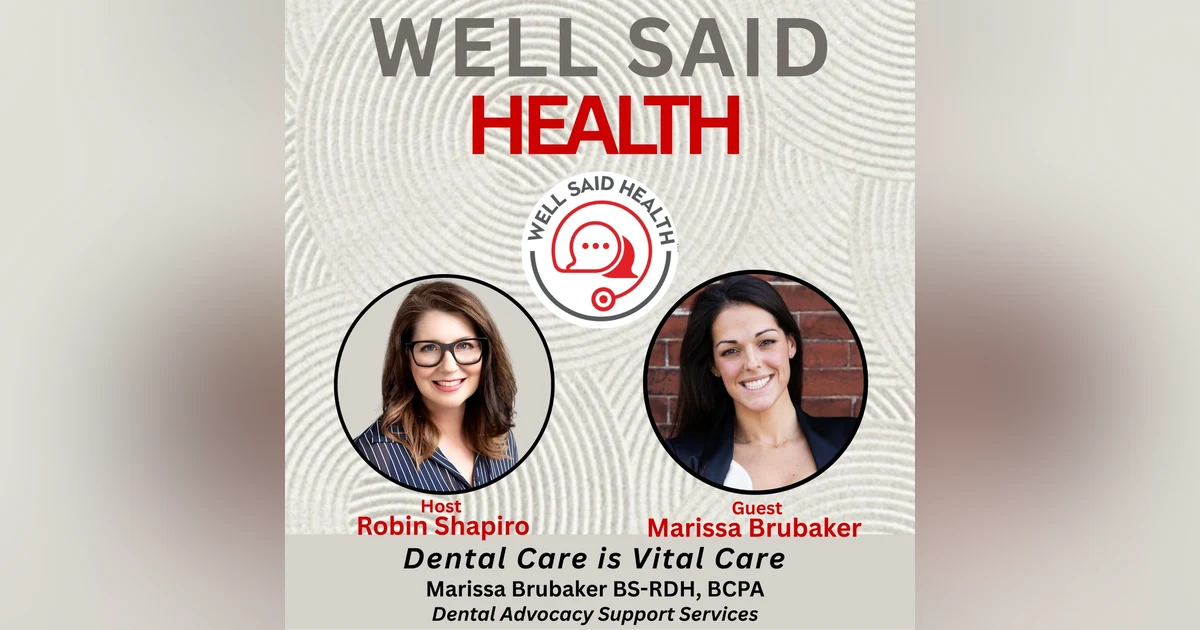


Your mouth is treated like it isn’t part of your body — separate insurance, separate providers, separate records.
Dental hygienist and Board Certified Patient Advocate Marissa Brubaker has spent 20 years as a dental hygienist, and one working interview with a mobile dental company serving seniors led to her career as a dental advocate. She explains why gums don’t bleed (tissue tears — and the bacteria head for your bloodstream), how dry mouth can quietly cascades into weight loss and withdrawal, and how her godfather Uncle Al’s oral cancer was missed because nobody looked or asked.
Then Robin turns it into a toolkit: the exact words for the dental chair, a big treatment plan, a second opinion — and one question to ask someone you love this week.
Link to full show notes: https://www.wellsaidhealth.com/dental-care-is-vital-care/
0:04 Welcome to Well Said Health. I'm Robin Shapiro. Every episode we take one healthcare situation where the right words can change everything, and we give you the language to handle it. Today's episode focuses on oral and dental health. Here's the strange truth about American healthcare. Your mouth is treated like it isn't part of your body. Separate insurance, separate providers, separate records. When Medicare launched in 1965, it didn't include dental and the Traditional Medicare still doesn't cover routine dental care today.
0:45 About 72 million American adults have no dental insurance. And in a recent national survey, fewer than half of adults knew the mouth and what happens inside of it is connected to heart disease at all. But it is connected to your heart, your blood sugar, your lungs, your brain. Now, your words matter, and that's what this show is about. This podcast is not medical advice. I'm not a doctor. What we do here is give you insight, education, and the specific words to ask for the care you deserve. Today's guest is Marissa Brewbaker, a dental hygienist with 20 years of experience in practice and a board certified patient advocate and the founder of Dental Advocacy Support Services in New Hampshire.
1:36 She's an insider's insider who chose the patient's side of the table, doing a job so new most people don't know it exists. She's going to tell you a story about tissue paper, and I promise you will never think about bleeding gums the same way again. And stay to the end because she has one question she wants you to ask someone you love this week. Here's my conversation with Marissa Brewbaker. Hi, Robin, thank you for having me. So so glad that you're here. So you're a dental hygienist of twenty years and you now do a job most people have never heard of. What is a dental advocate?
2:16 So Robin, I want you to think of a dental advocate the way you would think of any other advocate. I am here to help people navigate through a system that they are having a difficult time navigating through. For me it's dentistry because it's what my background is in. But I am here just as any other advocate is to help people regain their own voice and their own story. That's great. That's what this podcast is all about. And I wanna just take a moment to talk about what led you to this particular job. And you told me your swan dive moment came when working doing an interview at a mobile dental company serving seniors.
2:59 So would love to hear a little bit more about how that experience informed what you became, which is an independent dental advocate. Yeah, of course. So I was not new to dentistry, but I was relatively new to Florida. I had moved down there with my new and growing family. I retook my board so that I could be licensed in Florida. And all of a sudden a job popped up and it was for a mobile dental hygienist to service senior living and individuals in their own home if their family needed some help. So I was excited about the position. I went into it sorry eyed, definitely naive.
3:39 I picked up the mobile dental unit. I got my list of who I had to visit, and off I went in the company car. And the good vibes and good feelings left my body very quickly into the beginning of my day. So they had me going up and down you know, the Florida coast. There was no rhyme or rhythm to where they were having me going. I've realized very quickly that I was not going to be staying on time and that even with me not staying on time, I was not going to be able to service the patients in even a kind of helpful manner.
4:20 I ended up running so late. The quality of care was not what it needed to be. There were missing charts, missing Radiographs, and when I finally got back to the headquarters to drop off all of the dental supplies, you know, I was apologizing for being so late, past when they had expected me to be back, and I realized the only person who was surprised by my tardiness was me. The person who had me going facility to facility, she knew this was going to happen because this is seems to be what happens when she has people coming for a working interview and you know, her message to me was, you know what, we'll do it again, no big deal.
5:07 Just remember this isn't private practice. Do what you can. And so is this very typical for a mobile dental clinic and people who are seniors, maybe living in assisted living homes, to get this type of care? It's not uncommon. It's very difficult to do mobile dentistry when you're a for-profit organization because of the travel that is involved in it. You're working with a population that might have some limitations on what they're willing or able to do for restorative work and you have to make your money somehow.
5:48 So while I'm sure there are Better run mobile dental practices, this is not uncommon. And I left it feeling upset with myself for not being able to stick with the schedule. I was I felt sad for the patients and as my brain kept spinning that night, I realized one of the bigger issues I had was that this population of patients, whether it was the person who hired us for themselves or the family hiring us to take care of their loved one. Who are they going to complain to? So then I found myself, you know, going down the rabbit hole of looking at the reviews of that company and other companies.
6:33 And I could hear the frustration in the people writing their reviews and it matched exactly, you know, what I had experienced as a clinician doing my working interview. And I was sad to see that nothing was ne being done about it. And that was kind of what inspired me to want to have more of an active role in helping people find their voice and, you know, report where it needs to be reported and get the care that they deserve and that they're paying for. So I would imagine that care that is not optimal would be experienced not just in the kind of situation that you're talking about, but in dentistry in general.
7:15 What resource do people have to be able to provide feedback or report this kind of work so that things change? I do think that reporting it to the business or even if it's a private practice, reporting it to the dentist, I think it is a good first step. Sometimes it's not unethical practices that are deliberate. Sometimes it's lack of training. Sometimes it's unawareness. So I think it's a good place to begin, but I also think that if the situation doesn't feel as though it's being heard or remedied, there are other options. If it's an insurance billing issue, you can Call the insurance and report it yourself for them to investigate.
7:59 You can go to the attorney general. You can go to the licensing board. That's great advice. And one of the things, you know, I think a lot of people are afraid of the dentist or not really enthusiastic about the dentist. I was wondering, you know, what we, each individual, can be doing to make sure that our teeth are as healthy as possible. And you had an explanation for bleeding gums that was better than any that I had ever heard in terms of what we as an individual can do to help protect our teeth and gums and mouth. Can you ~ tell me about the tissue paper and the river analogy?
8:42 I would love to. My tissue paper analogy, just so it makes a lot more sense why a clean mouth is an important thing to have for all people. So a lot of times, Robin, I still work as a clinician. Patient comes in, I ask how everything's going. I can't tell you how frequently people tell on themselves that their gums are bleeding. And I listen to them and then they'll also mention their gum tissue. And if we stop and slow down and think about it, what is it? Is it your gums are bleeding or your gum tissue? Because we know that tissue does not bleed.
9:24 So let me make an analogy that will kind of clear up where the blood is coming from, because gums do not bleed, but there is blood in the mouth. So let's think about it. So ignore the mouth right now. And let's talk about tissue. Pretend that you have a couple pieces of gift wrap tissue paper and you're holding them with both, you know, each side in one hand, holding it really tight, layers stacked upon each other. Individually, the layers are pretty thin, but when you have them all stacked, it's a little thicker and heftier. Now imagine you're holding your taut tissue paper over a river. Now imagine on top of the tissue paper you put one big clumpy chunk spoonful of chunky applesauce right on top of it.
10:12 That tissue paper doesn't want chunky wet applesauce on it. So what is it going to do? It's going to slowly start tearing away layer by layer of the tissue paper, and it's not going to tear away in a perfect round circle. It's going to have uneven edges of the wet tissue paper and the top layers the most eaten through and then slowly it goes through and through and through until it rips through all of the tissue paper and clump it falls right into the river. Once the applesauce goes into the river, it's going wherever the river takes it. I have no control, you have no control. It can go upstream, it can go downstream.
10:54 Going back to the mouth. Gums Tissue, your gum tissue, it is tissue. It's a bunch of thin layers all stacked on top of each other instead of chunky applesauce, even though it could be chunky applesauce, it's plaque. It's steak that's been sitting on in between the teeth on the gums for too long. The gum tissue does not want it sitting on there. Gum tissue is delicate. So what happens? It starts to rip through layer by layer until plop. It falls into the river. Only the river is your bloodstream. But just like the river, we can't control where it goes because your bloodstream and circulatory system did not get the memo that insurance has told us, which is the mouth is separate from the body because it is not.
11:45 So the mouth has over 700 species of bacteria in it. You don't want that falling into your bloodstream. And that's what's happening. So Bleeding gums can just sound like an annoying unpleasantry when you're flossing or brushing your teeth. But there's so many consequences that come from periodontal issues and letting your gums get to the point where they've ulcerated through where that blood supply river is now coming up through it. Just like the river, if that bacteria is going north, your brain's not very far away. And there is a link between dental plaque being found in the brains of people who have suffered from Alzheimer's.
12:32 If it goes south, it can go down to your heart. Same thing. Plaque has been found in arterial plaque. And you know it's funny, I talk a lot about how separate dentistry can feel for a medicine and the issues with it, but sometimes it is recognized and there are certain conditions that require premedication because Science does know that the mouth is connected and the bacteria from the mouth can travel to the heart. And if you have certain conditions, they want you to take a pre-medication because it can lead to infective endocarditis. You know, and it's not just a body part thing, Robin.
13:12 It can be chronic. One of the biggest ones that I mentioned because it affects a good amount of people and it definitely if it doesn't affect you, you know someone that it does affect. It's the correlation between gum inflammation and diabetes. It's a negative feedback loop. A lot of times if you can get your gum inflammation under control, your sugar numbers come down. And it's a lot easier to keep inflammation down when your sugars are down as well. So that's where the negative feedback loop comes from. I think that's really interesting. So really paying attention to the teeth, if you could only do one thing between brushing your teeth and flossing or water flossing or doing something else, what would be the number one thing that everyone should do to protect their teeth and their gum tissue?
14:06 flossing and trust me it would about kill me if I couldn't also brush my teeth. But if I did have to just choose one 'cause I was on a deserted island, it would be flossing. If you're flossing correctly and not just going straight up and down, but you're actually wrapping the floss in more of a C shape around the sides of the tooth when you're going up and down. You're getting where the plaque is. Plaque doesn't just start, you know, on the chewing lower half of your tooth. Plaque starts up at your gum line and floss isn't just good for getting sugars out from in between your teeth where cavities have an easier time starting, but it really does pull plaque off of the tooth.
14:51 If I could only do one floss or brush, I would use floss hands down. That's so that's so shocking and something that I think everybody will kind of keep in their minds. So you've watched this play out quietly in senior living facilities and you've said that there are lots of different people who have a cascade of things happen related to teeth. So could you kind of give us a a scenario, kind of a composite of all the people that you've seen over the years and what to be aware of and how one thing can kind of lead to another. So I know we talked about all of the conditions that are affected by a dirty mouth, but when we think about these conditions on their own, we then have to think about what's next.
15:43 Well, medications exist, you know, for these conditions. And one of the biggest factors affecting somebody's mouth with medication is dry mouth. So a lot of times what I would see with senior living is There would be a client, they are on a number of medications managing their health conditions, their mouth becomes more dry because of the medication. Well, a dry mouth isn't just an uncomfortable mouth. Saliva is not just spit. Saliva is your body's natural defense system. So when saliva is taken away, plaque can stick to the teeth more easily, food sticks to the teeth more easily.
16:25 So now you're starting to look at Cavities and decay and old restorations that are beginning to break down a lot quicker because decay is setting in from the dry mouth. But nobody is going to complain that their mouth feels a little dry. They might start having some sips of water a little more frequently. But ~ yes, their mouth is dry now, their tooth might have broken. Now they have a tooth that's uncomfortable to chew on. So now, you know, nutrition starts to become affected. And again, their mouth isn't comfortable anyway from the dryness. A lot of the times the foods that start to go first are the more nutritious ones, it's your proteins. It's harder to chew.
17:07 So then they might not be eating the foods that they should be eating. They might start losing weight. Social withdrawal starts to happen. They might they're not going to want to join their friends in dining hall if they can't eat with them. And then by time Anybody notices what is going on with some of these people in senior living, it looks like depression, social withdrawal, weight loss, when really it started in the mouth. And by the time the mouth is even looked at, those other things are still real. Weight loss, depression, anxiety, they exist as well.
17:49 And then that's also what's now being managed, and maybe the mouth is being addressed. I know that we're gonna talk about a question that every person should ask their loved one to kind of get to the bottom of that. But before we do that, I wanted to hear from you a little bit about your uncle Al because dental and oral health is personal for you. You had your uncle Al, who was your godfather. Who was he in your family? What kind of a guy was he, Uncle Al? So Uncle Al was married into my family. He was my godfather from the day I was born.
18:30 Uncle Al very charismatic, very fun, very lovable. So when Uncle Al had met my aunt, they were back in high school. He actually they had their first kid when he was still in high school. So because he had a they had a child young, life got pretty serious pretty quick and he had to get a job pretty quick. So thankfully for him, he was very, very talented tradesman. He worked as a carpenter and did a lot of construction. But with that, you know, there comes a lot of damage to the body working in construction that long.
19:10 And from being young and being in that environment, you know, he found himself maybe making choices that weren't to his benefit. He definitely leaned on alcohol pretty heavily and that took a toll on his health. So super strong, super fun loving, awesome, awesome human being. Very, very talented. But you know, it's funny, Robin, when I think about my uncle and I think about the ways that we describe him. He's tough as nails, tough as nails. And he was tough as nails, but we say it. Like it's this great thing and it made me start wondering if it really is a great quality because Uncle Al lived with a lot of pain for a very long time and it wasn't always addressed.
20:05 Sure the major situations were addressed, the ones he couldn't ignore. You know, it's easy to ignore prevention, it's impossible to ignore emergency. So if he's having a steel beam fall on him He needs to address that. When he had a stroke, he had to address that. But there was other underlying pain that he was used to for a very long time that he did not address. Uncle Al has three children. One of them had passed away in his when his the son was in his twenties. Uncle Al very much enjoyed his time with his two living children, my younger cousins.
20:45 They are now adults. So they would meet up once a month, always going out for Greek food. Every time they would go out, Uncle Al got inarguably the best food item on a Greek menu, which was baked lamb garnish. He would complain about his mouth, and for years he complained about his teeth. He ended up actually losing all of his teeth close to around the time that he had his stroke. They weren't related, but He was a dentalist and was having issues with the dentures fitting. He didn't even know he had dental insurance, so he didn't really take care of it. But he would mention it every now and then at lunch.
21:26 Well, the last time they went out to eat at the Greek restaurant, he did not order the bakeland garnish. He ordered soup. And one of my cousins said, Dad, why are you getting soup? No one would get that here. As their main entree, at least. And he said, Yeah, don't worry about it. Again, he's tough as nails, which not always a good thing. Don't worry about it. I just want to spend time with you guys. It actually it hurts too much to chew the lamb. I'm good. And my cousin knew this was a huge issue because she had already been hearing about his dental pain and now it's progressed so far that eating a piece of meat that's been boiled down in juices for hours is too painful.
22:09 It shouldn't be. So from there they ended up going to urgent care and straight from there they sent him to the hospital where he was diagnosed with stage four oral cancer. Hm. ~ awful. And he had dentures at the time. He had dentures, but they weren't really fitting because they weren't comfortable. And every time my cousin would tell him, You need to be seen, you need to be seen, and this was before he got the diagnosis, the way he saw it was, it's fine, I'm fine, I'll deal with it. And who am I gonna go see?
22:50 I'm not gonna go to a dentist, I don't have any teeth. Which isn't true, but it was true to him because he was unaware that even if you don't have teeth, you should still be seeing your dentist once a year for, you know, or oral cancer exams. Right. So if you could turn back time, what do you wish someone had asked him and and when that you think could have changed the trajectory of his diagnosis and disease? I wish many different things, Robin. I wish one that when he left his dental appointment with his full set of dentures. I wish that he was educated on the fact that he is not through being a patient there.
23:36 He still needs to be seen once a year because he would have made an appointment and he would have gone. But he didn't know that. So he thought that his days at the dentist were done. And I also think all of the of all of the medical appointments he had, all the rehab appointments he had after his stroke, it wasn't as though he didn't have a doctor and wasn't being seen or that he was scared of going to a doctor. The mouth was being ignored and it wasn't being looked at. I wish that when they were asking him his questions about how he's doing it. Again, even with the stroke, that it went beyond, your speech is improving and that somebody treated the mouth as if it's part of the body because it is and it was missed when it didn't need to be.
24:27 Yeah, so so tragic. It was very sad and you know, I he wasn't ready to pass and it happened quick. He passed away within within six months and he actually died on Christmas Day. It was very sad and it wa I feel as though it was very preventable. It was just in an inconvenient place for anybody to think of looking. Yeah. So why is dentistry separate from the rest of medicine? So the body is integrated but the healthcare system often isn't.
25:09 I don't think that science is unaware that the mouth is part of the body. The separation happened because education, licensing, insurance, they all evolved separately. You know, I think even when Medicare, you know, was created back in, I believe, nineteen sixty five, there wasn't a routine dental care benefit attached to it. You know, so It's just an example of the evolution of different bodies going in different directions, you know, so history be explains how they became separated, but it shouldn't remain separated. Dental insurance plans, they're all so different.
25:50 Even under the same umbrella, they vary so much plan to plan, state by state. One of the biggest issues I see is When somebody is choosing a dental plan and they have different plans lined up next to each other and they're going line item by line item, trying to compare what the best benefit, especially for what their needs are going to be. What a person often doesn't know is how many dentists and which dentists. Dentists and dental offices are actually in network with these plans. You could have two plans next to each other. They could be the exact same plan.
26:33 One could be twenty dollars less. I would if not knowing what I know, I would do the twenty dollar less plan, and most people do. The problem is you then get the plan and you look for a provider that's in network and it might not be who you would have chosen if you weren't limited or guided by your insurance company. So I won't say every medical dental plan isn't a good one to choose, but I have yet to see a medical dental combined benefit where the reimbursement for the dental office is one where many dental offices want to participate with it.
27:16 So how do people choose then? I mean, what do you recommend that they do to have a better understanding of the trade-offs between the lower cost and the better coverage? Is there something to be able to do about that? I think that a great place to begin is to find a dental office or dental practice that you could see yourself going to and then reaching out to them and seeing if they participate in network with any company, you know, dental insurance companies, finding out which ones they are and maybe comparing plans at that point. But when you're just going online and trying to find the cheapest plan that has the most benefit to it, you might be selling yourself short in the long run.
28:07 And of course, people have to do that in the fall when it approaches open enrollment because there's only one time a year to be able to do that. That's just like a little tip for people. Which leads us into our next segment, which is called the toolkit. So we love to ask our experts and guests things to say and do to navigate care better for that particular health topic. So if you have no insurance, a toothache, and $200. What are the three things that you should be looking for, asking for as you navigate your care? We all know that the two hundred dollars is not going to go far in dentistry, so you gotta choose wisely.
28:51 ~ what I would do in that situation, I would put that two hundred dollars towards a new patient exam so I can learn what the problem is, so I can then learn what my options are and come up with a way that I'm gonna finance the option that, you know, supports my goal. Because the two hundred dollars can cover an examination and some x rays, if not a set of x rays. So I would use it for discovery. A lot of dental is so expensive. So let's think about you're facing an $8,000 treatment plan, which is probably not unusual if you need a lot of work.
29:37 What's the one question to ask before saying yes to proceeding with that expensive plan? I think that the question to ask is really a question to ask yourself. And I think the question is do I understand what the problem is? Did I have options? And do I feel comfortable moving forward with what the option is? You know, I think a lot of times, you know, buyers regret, especially in dentistry, comes from lack of communication or misunderstanding and feeling pressured. But I think that if you're presented with any treatment plan, whether it's eight thousand, thirty thousand, sixty thousand, an informed person is going to feel more confident moving forward when they are informed of what why that treatment is being recommended.
30:33 You know, there needs to be value behind it to feel comfortable moving forward. Yeah, and you know, I mean, there's right a wide range of practitioners who have maybe good bedside manner, not such great bedside manner, good outcomes, not such great outcomes. When is a second opinion a non-negotiable? And how do you get an honest second opinion? Because there is some question about whether or not all dentists are Ethically treating patients. I know that that's come up a bit in my research. You know, first I wanna say that a second opinion, whether it's in dentistry, healthcare, anything, it's not a slam on the first practitioner and it's not saying that they're wrong, but decisions are sometimes permanent, they are expensive, and if a person is not one hundred percent comfortable moving forward or still has questions even after their appointment, that they don't feel it will be addressed the way they need it to be addressed.
31:44 A second opinion is always a great idea. Clinicians, I will blanket us. We want patients to be happy and it's easy to present information in a way that will support their happiness, especially if they're new to your practice. I think that a way For a patient to come into a second opinion that is going to be most helpful to them is to come into it not with their list of all the things that they did not like about that first practice, but instead coming into it almost as if it's a brand new fresh set of eyes and using the experiences that they had that they did not like at the dental office and presenting it.
32:32 more in a way of this is important to me is going to give more of a comprehensive real appointment instead of saying the last dentist was talking to me, I didn't know what was going on. So coming into it, treating it almost as if it was new and using your goals as the main talking points instead of how your goals weren't met at the last practice. Mm-hmm. Mm-hmm. So if you could give every listener one question to ask someone they love this week, what would it be? Keep the question open ended and instead of saying is your mouth feeling okay?
33:18 Ask them how is everything feeling in your mouth? Or tell me how your mouth has been feeling. I think that's great. Before we wrap up, is there anything that you would like the listeners to know about asking questions, asking any additional questions that are essential for good dental or oral care? I would want for the listeners to know that it is okay to have to have a dentist one repeat what they had just said and it is okay to ask them to repeat it in a different way or to present that information in a different way.
33:59 We try to be mindful as clinicians, you know, to not to speak in dental ease, but sometimes when we think that we aren't, we still are, and we would much rather know what we need to rephrase so that somebody can understand what we're seeing. Don't be afraid to ask questions and to speak up and to slow down the appointment if it's going too quickly for you. So what does that look like? Slowing down an appointment could asking for a break in the middle of a cleaning and asking to sit up. If you need to regather yourself, you can say that you need to go to the bathroom so you can stand up, leave the room, reset, and come back.
34:47 It's okay to ask if you can reschedule the appointment because it's going It it's too much for you to handle. And it is okay to ask to come back for a problem focused sit down where you can go over a treatment plan over again because you didn't understand it the first time or because you need more clarification if they're running short, you know, they don't need to schedule an hour, but there should be no problem scheduling an additional fifteen minute appointment to support what they began to explore and present at your first appointment with you. Amazing.
35:27 Marissa Brewbaker, thank you so much for joining us on Well Said Health today. You can find Marissa at dentaladvocacy.com or in the GNA directory, and we'll have all the information in our show notes for more information about Marissa and what we've talked about today. Thank you so much. Thank you, Robin. That was Marissa Brewbaker, Dental Health Advocate. And stick around after the episode to hear Marissa's personal health hacks. I want to pause on what I think was so valuable about what Marissa taught us about today. I mean, I can't stop thinking about the tissue paper and bleeding gums.
36:11 I know I'm not gonna skip flossing again ever. And what I keep coming back to is Marissa's Uncle Al. The difference between the story ending the way it did and ending another way wasn't about money and it wasn't about medicine really. It was a question nobody asked. So let's make sure that never happens for the people we love. So for this language toolkit, here are the exact words I want you to have. Write these down, put them in your phone. Number one, for someone you love this week, ask them. Tell me how your mouth and teeth have been feeling. Open-ended, no, yes, or no.
36:53 If they wear dentures, add, how are they fitting? Any sore spots? And remember, a mouth without teeth still needs a dentist at least once a year for oral cancer screening. Number two, facing a treatment plan at any price. Ask the provider, help me understand the problem, walk me through my options. And can this be phased like not done all at one time? What is the biggest problem first? If you can't picture the problem and repeat it back, you're not ready to say yes. Number three, getting a second opinion. Don't open with everything the last dentist did wrong.
37:34 You'll get a softer version of the truth. Say, it's been a while since I've been to the dentist, I'm looking for a comprehensive evaluation, here's what matters to me. Most. Your goals, not your grievances. Number four, if an appointment is getting too intense, you can ask to take a break or see if they can finish at another appointment. Your homework this week, yes, we have homework. That's how the show works, is two things. First, ask one person you love the mouth question. One person this week. That single sentence is the whole episode in nine words.
38:14 And if you think it will help, you could even share this episode or talk with your loved one about the tissue paper analogy. I know I am. Second, if money is a barrier for you or someone you're caring for, take one step by looking at dental school clinics, which run about half the cost of private practice. Community health centers charge on a sliding scale. And if there's an infection and no dentist in sight, a hospital can help. Nobody has to live with an abscess. Full show notes are at wellsathealth.com, including a printout of these scripts, how to reach Marissa at Dental Advocacy Support Services and in the Greater National Advocates Directory.
38:59 If Wellset Health is useful to you, it would mean the world if you take a few moments and leave a review wherever you listen. It helps other people find the show, and that's the whole point. I'll be answering listener questions and taking topic ideas through my newsletter. You can sign up at wellsaidhealth.com. I'm Robin Shapiro. Thank you for being here, and here's to your good health.
39:43 We all know that floss my teeth every night, but moving away from the mouth, I really enjoy weightlifting and I enjoy getting my cardio from tennis. So I like to change it up. It keeps it fresh for me. I sometimes have found that too much time doing the same routine, you know, you start to get a little bored with it. So I try to keep it fresh by trying different things in the gym.