Keeping Your Loved One Safe in the Hospital
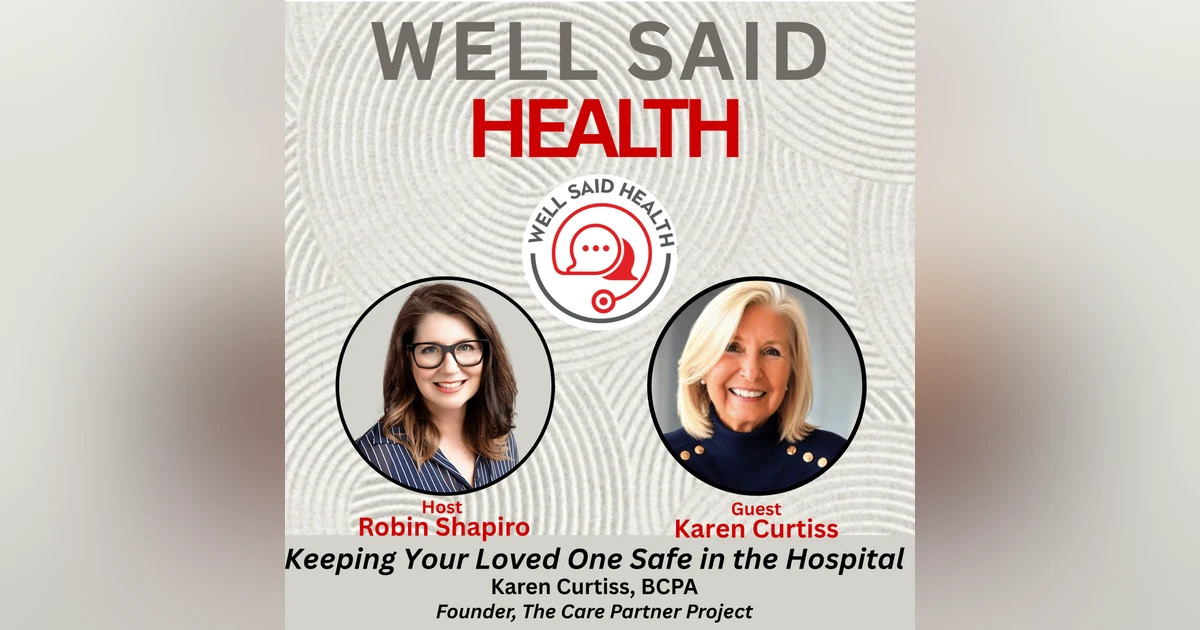


Roughly one in four hospital admissions involves an adverse event — harm from the care itself, not the illness — and about a quarter of those are preventable. Patient-safety experts have a name for the worst of them: never events, the ones that should never happen to anyone. The phrase attached to them is “common and preventable.”
Karen Curtiss learned that the hard way. In 2005 her father, Bill, got a lung transplant at 72 — then fell, waited 57 hours flat in traction for a five-minute exam, and spent seven months fighting pneumonia, MRSA, C. diff, a blood clot and a bed sore. His death certificate said pulmonary fibrosis. Within the year her husband nearly died of sepsis after a “routine” surgery, and her nine-year-old son was almost rushed into an operation he didn’t need. So Karen founded The Care Partner Project, which gives families free, vetted checklists for every hospital stay.
In this conversation, Karen shares what she wishes her family had known — and the exact, kind words to use when a nurse’s gloves touch the bed rail, when a new medication arrives, when nobody is coming, and when a discharge isn’t safe.
Full show notes at: https://www.wellsaidhealth.com/keeping-your-loved-one-safe-in-the-hospital/
0:00 Robin Shapiro: Welcome to Well Said Health. I'm Robin Shapiro. Robin Shapiro: Every episode, we take one healthcare situation where the right words can change everything, and we give you the language to handle it. Today, a man named Bill gets a miracle. He's 72 years old. He has lung disease, pulmonary fibrosis, with no cure except for a lung transplant, and against all odds, he gets a lung transplant at the number one center in the world. Robin Shapiro: The surgery takes nine hours. It goes beautifully. His doctor tells him, "I see you being on the golf course by the Fourth of July." Four weeks later, he falls on his way back from the bathroom and bumps his head. It's a Friday morning, 11 o'clock. The staff put him flat in traction just as a precaution and promise a specialist will look at him by dinnertime.
0:59 Robin Shapiro: Nobody comes Friday. Nobody comes Saturday. Fifty seven hours go on before the evaluation happens, and the exam, when it finally comes, takes less than five minutes. His daughter spent that weekend calling the nursing station a thousand miles away, wondering whether to get on a plane. Her name is Karen Curtiss, and what she learned in the seven months that followed changed what she's done with the rest of her life. Robin Shapiro: Today, we're talking about something most people don't know they need: how to help keep someone you love safe in the hospital. Research suggests that roughly one in four hospital admissions involves an adverse event, a harm from the care itself, not the illness, and that about a quarter of those are preventable.
1:50 Robin Shapiro: Medicare keeps a list of a couple dozen events it says should never happen to anyone. The phrase attached to them is common and preventable. Sit with that pairing for a second But here's the empowering part. If you have ever sat in a hospital at the bedside, and there are tens of millions of us in this country, you are not a visitor, you are part of the safety team. Robin Shapiro: A family member at the bedside with the right words is the safety net nobody issues you at admission. Your words matter, and that's what this show is about. The podcast is not medical advice. I'm not a doctor. What we do here is give you insight, education, and the specific words to ask for the care you deserve.
2:38 Robin Shapiro: My guest today is Karen Curtiss, a board-certified patient advocate and the founder and executive director of The Care Partner Project, a nonprofit that puts free, fully vetted hospital safety checklists into the hands of ordinary families. She wrote the book Safe and Sound in the Hospital, and I've been learning from her ever since I first heard her story at a conference in 2009. Robin Shapiro: She's going to tell you about her dad and about the exact words to say to a nurse whose sterile gloves just touched the bed rail kindly and without becoming the difficult family. And she'll give you the four things every care partner needs to know: what to look for, what to say, what to do, and when to get a nurse.
3:26 Robin Shapiro: Here's my conversation with Karen Curtiss. Robin Shapiro: So Karen, take me back to 2005. Your dad was 72 years old, and he's been carrying a secret. What is the secret? Karen Curtiss: Yes, Robin. Thank you for hosting me here today. This story is quite remarkable in many ways, and number one is that he did keep this secret. He was diagnosed with pulmonary fibrosis in his mid-60s, around age 67, and he shared it, remarkably, only with my mother, who told no one. Karen Curtiss: And the reason for that is because he wanted to live every day to the fullest. He did not want people to ever feel sorry for him. He wanted all of the guys that he played golf with to keep calling him to play golf, and he would for as long as he could, and he even played tennis. And at a certain point, he was still riding his bike when he was on supplemental oxygen, and he didn't tell the family, we had six kids, until he was at end stage, which means that, you know, your horizon is pretty short, and at that stage, most people qualify for palliative, if not hospice care Robin Shapiro: And you told me that the one cure is a lung transplant and that he was past the cutoff age.
4:53 Robin Shapiro: So how did the family fight that? Karen Curtiss: So 65 approximately is about the cutoff age, and then by this time, Dad was, like, 71, I think. So my background is in marketing, and I just decided that I was going to package him up and present him and market him as being biologically younger than his chronological age. Robin Shapiro: I love that. Karen Curtiss: And since I've become a patient advocate, I really understand that this is something that all advocates do. You compile all the medical records. They're highly organized. They're highly detailed. They're easy to follow so that any physician that is reviewing them, it, you make their lives easier, and that's exactly what I did.
5:37 Karen Curtiss: Mom and Dad were living in Florida. I live in Chicago. I got on a plane. I flew down, and Dad and I organized all of his records in a neat binders. He had collected letters from the physician that had been caring for him over the years to say, "This is a compliant," you know, that's a good buzzword to remember, that you're a patient who follows the rules and follows instructions to the letter, and Dad was that. Karen Curtiss: Plus, how do you argue with somebody who, until a few months ago, had been playing tennis? So- Robin Shapiro: Mm-hmm ... Karen Curtiss: it was clear that, the resolve was there even though maybe the lung capacity wasn't quite there. You know, he's used to pushing through a lot of things to live fully. And so that's what we did, and we sent them off.
6:22 Karen Curtiss: I did a ton of research to find out, how do you max out your odds for getting a transplant? Like, what are the criteria that are followed? And I learned that you really wanna go to a high volume transplant center, and as you and I have often discussed, yes, you wanna go to the person who is going to do surgery, that they've done it a million times. Karen Curtiss: They've seen everything, so they can anticipate anything that comes up. Robin Shapiro: So they would be more likely to take the risk on him. Karen Curtiss: Exactly. I sent out, by FedEx, 16 of these folders, and I followed up. Where I could, I cold called, surgeons, and I sent faxes because- They all still What year is this? Now, this is a long time ago.
7:11 Karen Curtiss: This was 2005, and some things have changed. He first had to go through an exhaustive series of, t- took a week of tests and counseling and coaching with both Dad and my mom. The highest risk for a transplant is a male without family, because that family support means a lot. And so Mom was interviewed as well. Karen Curtiss: And as a team, I believe they were accepted. Robin Shapiro: So he had six to eight weeks to live, and the transplant list runs 18 months long. So what happened?
7:51 Karen Curtiss: So, still held out hope and By now, Mom and Dad had relocated to the city where the transplant center was, and they had their little apartment, and at 4:00 in the morning they got a phone call, "How soon can you get here?" Karen Curtiss: Because there was a woman on the list ahead of Dad, and the lungs came from Missouri, a few states away. A 39-year-old young man had died in a motorcycle accident, but it was brain death. He did not survive the crash, and he was an organ donor. So the lung was transported by flight, and the woman who was at the top of the list was not strong enough- Robin Shapiro: Wow Karen Curtiss: to withstand the surgery. It's a nine-hour surgery, and she was just too fragile.
8:48 Robin Shapiro: Oh, wow. Karen Curtiss: Can you imagine how her family felt, how she felt? Robin Shapiro: Yeah, yeah. So it's February 23rd. Karen Curtiss: Mm-hmm. Robin Shapiro: Nine hours of surgery. What did the doctor say afterwards? " Karen Curtiss: It went so well, I see you out on the golf course by the 4th of July." Karen Curtiss: And that was the Holy Grail, and there was six weeks ahead in the hospital of rehab. That's just a given for everyone. Robin Shapiro: Yeah. So four weeks in to rehab, right? And two weeks from discharge.
9:28 Karen Curtiss: Yeah. Robin Shapiro: He falls, hits his head. Tell us what happened. Karen Curtiss: So he was just coming back from the bathroom, and the nurse had escorted him there because he had been walking earlier. Karen Curtiss: He'd been doing his laps around, and she said, "You know, you've been exercising. Here, I'll, I'll escort you to the bathroom. Wait for me." And he just got tired of waiting, you know, and you can imagine she was pulled in so many directions. Robin Shapiro: As they are. Karen Curtiss: Yeah. So he just got up, but he took a fall, and he hit his head, and a goose egg raised up. Karen Curtiss: And then just to be on the safe side, they said, "You know what? We're gonna put you in horizontal traction just to be absolutely certain there isn't any neurological damage. But, uh, you know, it's only gonna be for a couple hours. Somebody will surely be here by dinnertime." This was, like, 11:00 in the morning.
10:21 Karen Curtiss: So, you know, dinnertime came and went on Friday. The entire day went by on Saturday, and Mom kept asking when I was calling, and it was pretty clear that the young resident or intern was terrified to call a doctor at home and get any action. And you can understand that too. That's... But in any event, nothing happened until Sunday evening when I lost my mind, and I'm not very proud of this. Karen Curtiss: I called the nurse's station and just railed I'm not proud of it. I know what to do now, but a neurologist showed up pronto, administered a five-minute test, which was, "What's your wife's name? Who's the president? What time is on the clock? Follow my fingers. Follow." And he passed, but by the next morning he was in the ICU with pneumonia, which is the inevitable result almost of being, lying flat and having the fluids accumulate in your lungs with no activity, no way to clear the fluid.
11:34 Robin Shapiro: So the dominoes kept falling. Just awful. I'm so sorry this happened to your family. So walk me through the next seven months. Karen Curtiss: Well, in the ICU, people are at risk, higher risk than the average stay on an acute care floor for hospital-acquired infections because their immune systems are typically pretty low or suppressed, and also bugs are just everywhere. Karen Curtiss: Superbugs are everywhere. And so Dad did pick up a MRSA infection, which had to be treated, and he was, so he was in the ICU for, like, I think at least a week. So back to the recovery floor, trying to get back into the swing of things, of walking, but because his immune system had been pretty much pummeled by the antibiotics even further, he ended up with another hospital-acquired infection called C.
12:37 Karen Curtiss: diff. It's terrible. Back into the ICU, where there's no exercise. You don't get up and walk around. So he got out of the ICU, and then a blood clot had formed in his... It was actually in his arm, and it was on Friday afternoon discovered, oh, you've got this blood clot, and they decided to take a wait and see over the weekend. Robin Shapiro: Why does everything happen on the weekend? That's my big question on these podcasts, if listeners can appreciate that so many things happen on the weekend, which is the worst possible time, and I know you have checklists and all kinds of advice about that to share with us. But ugh, gosh. Okay, blood clot in his arm on Friday.
13:24 Robin Shapiro: It Karen Curtiss: traveled to his lung, to his new lung, impairing its function. Robin Shapiro: Oh, no. Karen Curtiss: Yeah. So back to the ICU, another round of MRSA, and this, that's what happened. It just... And in fact, he also was suffering with a bed sore, which he came out of the nine-hour surgery with a stage one bed sore. Those stage one bed sore kept progressing to two to three to four until it was a terrible open, gaping wound, which is a highway for infection. Karen Curtiss: So we ended up calling a wound specialist at, at another university where my sister had actually gone to nursing school. And the interesting thing about that, for those of you who have nurses in the family and you think, "Oh, okay, we're home free. We don't need to learn any of this stuff because we've got a nurse in the family," well, guess what?
14:14 Karen Curtiss: Nurses are so highly specialized, so she didn't see all these things that Dad was going through. I mean, yes, she knew the vocabulary far better than we did, but she was also at a loss of, like, how can you proactively... And we actually did call a meeting in his ICU room with all of the people involved in his care, all the physicians, and we said, "Okay, look, we're here every day. Karen Curtiss: What can we do to pitch in? What can we do to help?" And they basically said, "There's nothing you can do." Robin Shapiro: Oh. Karen Curtiss: I don't think they actually thought there would be because In, in medical and nursing schools, you're trained to treat the problem, not prevent it.
14:56 Robin Shapiro: Yeah. Karen Curtiss: Prevention's not a big part of the curriculum. Robin Shapiro: Yeah. So we're gonna get into that you disprove that, you know, over the following 21 years up until today. So also, your framing on providers doing what they are taught to do, which they're trying to do their very best and trying to take care of our loved ones. Karen Curtiss: And they're stretched, which is why I kept s- thinking to myself, "You have this army of people here. Karen Curtiss: We are invested. We want to help." And honestly, it is great therapy, because when you are so worried, you think, "Oh my gosh, you know, like, just give me an alcohol wipe and a bleach wipe and I will clean this place from top to bottom."
15:44 Robin Shapiro: Yes. You're doing something that is contributing to your loved one's health. Karen Curtiss: Yeah. Yeah. Robin Shapiro: Sadly, your dad was buried on September 30th. Karen Curtiss: Mm-hmm. Robin Shapiro: What did his death certificate say and how did you feel about that? Karen Curtiss: His death certificate said complications from pulmonary fibrosis, and in fact, it was complications from hospital-acquired infections. But to the family, that just felt so disrespectful. Karen Curtiss: He had overcome pulmonary fibrosis through sheer determination, resolve, patience, a lot of good luck, and I felt that it was very disrespectful to put that on his death's certificate.
16:33 Robin Shapiro: Well, and what that did for you, I think, also, was it lit a fire because you knew that that wasn't quite true, and I think it was, like, one, one piece of straw, right? Robin Shapiro: One piece of straw. You're collecting a lot of straws. We're gonna move to your husband. So after your dad died, your husband went in for a routine surgery. Karen Curtiss: Yes. He went in for what's called a bowel resection to treat diverticulosis. My husband's primary care physician referred my husband to the doctor's friend, who had his office next door to him on the same hall.
17:15 Karen Curtiss: And this friend had said, "You know, if you get any cases like this, I really need more practice." And would you kindly refer them? Robin Shapiro: That's what the surgeon said to your husband's doctor, unbeknownst to you and your husband. Karen Curtiss: Yes. It does happen. But we didn't know, and should have known, and it's in our checklist now, w- when you get a diagnosis and you get a referral i- like this, you go to somebody that your own doctor doesn't know, 'cause doctors are really loathe to second-guess their friends' opinions or to counter anything, and you want somebody who's done... Karen Curtiss: who could do them in their sleep because they're just so good at them. They've done so many. Well, this person fit neither of these criteria, and my husband paid the price in that he ended up with sepsis, and then he was in the ICU battling for his life.
18:14 Robin Shapiro: Tell people what sepsis is, because not everybody knows what that is, even though we all should know what it is. Karen Curtiss: Yes. It is an, it's an infection that goes through your bloodstream, and when it goes through your bloodstream, it is a highway to deliver that infection all over your body, and it's... and you can go from getting that infection to organ failure really quickly. It's very important that it get diagnosed. And there's a great website called endsepsis.org, and you can learn more about it. Robin Shapiro: Oh, thank you for that resource. So back to your husband. So he got sepsis. Karen Curtiss: Yes. And then on top of that, he got another hospital-acquired infection called VRA, which is a very, very difficult hospital-acquired infection because there's no one antibiotic that they know that treats it. They kinda look at it as like a cocktail of antibiotics.
19:10 Karen Curtiss: And they did not have an infection person on staff at that community hospital. And this is my first, I think probably the first time I really realized that I needed to speak up, and actually I started crying because they told me that they were... "Yeah, I grabbed my friend in the hallway," this is what the doctor said, "and we kinda talked about, like, what would be a good combination of antibiotics for your husband?" Karen Curtiss: And I was like, "No- What? ... no, no." Yes. I said, "We're- there's no guessing going on here." I said, "I want you to go to the infection person at your competitor hospital across town and get them in on the consult." "Well, we don't work with them." I said, "You are now," I said. And of course, but I overheard them. This is the craziest thing, is I'm at the nursing station, you know, the tears coming down, and s- and really my segue into it is, "Look, my dad, we just buried him from hospital infections."
20:08 Karen Curtiss: And I said, "There's got to be more we can do here now." And I overheard a doctor saying, "Okay, she wants us to call the infection person over at this other hospital," and, you know, "She's, she's very emotional because she lost her dad. She's very emotional, so let's pat the little lady on the head and appease her." Robin Shapiro: And they did it? Karen Curtiss: Oh, they did it. It worked. Robin Shapiro: All right. All Karen Curtiss: right. Do what you gotta do. Robin Shapiro: Do what you gotta do, right. Pull it out. Karen Curtiss: Yes. Yes. 'Cause that's one of those things I used to say with my dad, I felt like I had a PhD before he went into the hospital in Google University, but all of that went out the window.
20:54 Karen Curtiss: I don't think I looked up much of anything because I was so in the throes of being terrified all the time. And with my husband, I went back to Google University and looked up, oh, VRE. Oh, this is really bad. Robin Shapiro: So and then it was Alex, your nine-year-old- Karen Curtiss: Yeah, Robin Shapiro: my baby ... right after that. So tell us about that third time of facing something. Karen Curtiss: In a year. So Dad was in September. My husband was treated and nearly died the following December. He had to go back in the hospital to have all of the surgery redone at a different hospital in May, and he had recovered enough to do that. Well, the week after he was discharged from that, our little Alex, nine years old at the time, got up in the middle of the night and severe stomach pain.
21:45 Karen Curtiss: Severe, severe. And I thought, "Okay, he's got gas. We'll just walk around the yard, and it'll, it'll resolve." It did not. It did not. So I took him to the local, a different hospital than my husband had been in- And they grabbed him. He really was in a lot of pain, and immediately gave him morphine and scanned him. Karen Curtiss: They thought, "Okay, he's got appendicitis. He must have it." And the scan, the doctor said, "You- we're not showing an enlarged appendix here because your son is so skinny, and the only way we see an enlargement if, if it's encroaches on the fat around it, and we're not seeing that." It wasn't adding up to me.
22:30 Karen Curtiss: And then I heard him on the phone, it was Memorial Day weekend, calling around to see if he could get a surgeon in on this Saturday morning, and he dialed the doctor who had done my husband's surgery that was such a disaster. Oh, my gosh. And so I said to the nurse, I said, "On the QT, if Alex really has appendicitis, how much time does he have?" Karen Curtiss: And she said, "A couple of hours." And I said, "Well, I'm driving him down to Children's in Chicago, Children's Memorial." And they said, "We can't let you go because you can't be responsible for the s-" And I said, "Yes, you're right. I get it." I said, "Let's get an ambulance to take us down there." And the doctor just went nuts, and he called me a bad mom.
23:14 Karen Curtiss: He said, "If I... If he were my son, he would be in surgery by now." And I said, "I... No, no. We're getting another opinion. We are getting another opinion, and we have the time to do it." And he's following me out as Alex is being loaded into the ambulance, and he's telling me, "Do you know how expensive this will be for you?" Karen Curtiss: And I was like, "You're really throwing everything at me, aren't you?" So we went down to Children's. We got there by 8:00 in the morning. They did a whole different, all different kinds of tests than they had done up at this local hospital. And they discharged him at noon, saying he had a bug that had been going around.
23:58 Karen Curtiss: He was fine. And I got him his favorite drink, chocolate drink, called my husband, said, "Come pick us up." And he was playing baseball by 3:00 Robin Shapiro: That's making me cry thinking about a surgery that he could have had unnecessarily Karen Curtiss: Yes. Oh, yes. That's when the mama bear comes out, right? It's like, okay- For sure ... if there's ever a... Karen Curtiss: Like, you wanna be so even-keeled Robin Shapiro: Absolutely. You held it together through all of it until you didn't. So can you take us through what you did? You had these three super intense, tragic experiences. So what did you do with that?
24:44 Karen Curtiss: My background is in marketing and market research, and I thought, "I need to drill down. Karen Curtiss: I need to research and find out what happened," because at first you think, "Oh, it's bad luck." You know, everything that went ha- happened with Dad, it's, "Oh, it's bad luck." And then with my husband, I'm starting to see this pattern here, and, uh, it, and s- so, like infection, I had never heard of hospital infections before, and now I'm hearing about it. Karen Curtiss: It's a daily conversation So I did Robin Shapiro: I mean, you bring up a really good point for all of us, which is if you are just having one terrible experience, you don't have any perspective about how common so many of these things are. And, you know, the universe or whatever gave you all of these things together in such a compressed fashion to have you be thinking about and digging into a little bit of what's really going on here.
25:45 Karen Curtiss: Exactly. Exactly. Because I learned it's not just bad luck, and in fact, when I listed all the things that happened to Dad and my husband, I saw a lot of... many articles about using this term never events, meaning these are common, preventable, they should never happen to any patient. And Medicare actually stopped paying for treatments for what they deemed preventable never events.
26:28 Karen Curtiss: So hospitals around that time, this was all hooked up to some accountability things that were built into the Accountable Care Act and some innovation that was going on then. Robin Shapiro: So when was that? Karen Curtiss: Those were the early days. By then it was about 2000. The reimbursement piece of it didn't come until later when the Obama, the Accountable Care Act was being crafted, but this was, the conversation was starting. Karen Curtiss: And, and in fact, there was a study around 2000, To Err Is Human, that documented the prevalence. It was the wake-up call, 100,000 people a year die from preventable infections that they've picked up in hospitals.
27:18 Robin Shapiro: To Err Is Human. We'll put that in the show notes because that is such an impactful study. I'm trying to think back to the time when they were saying that the preventable medical events that lead to death in the hospital and figured out that it was... Robin Shapiro: If, if it was in the leading indicators of leading causes of death, it would be actually the third leading cause of death. I remember hearing that statistic and thinking that can't possibly be the truth. It's one of the things actually that really motivated to continue to work in this area because it's so prevalent and no one knows and no one talks about it.
28:00 Karen Curtiss: I think about it as 1,000 deaths a day on average, and that would be three planes crashing every single day with no survivors. Wouldn't we pay attention to that? Wouldn't we be looking to the FAA? Who would be getting on a plane? Robin Shapiro: Yeah. And I mean, the point of the show is not to have people so afraid of going into the hospital. Robin Shapiro: The point is, and I think what we're gonna get to a little bit later in the episode here, is that there is so much that individual patients and family members can do. And armed with the knowledge and the confidence to navigate care better, you will end up with better care.
28:49 Karen Curtiss: Yes. And I have to say too, I do feel that the care providers are different on the whole. Karen Curtiss: I've always, like, felt really good about them as people, but I haven't felt good about the way they've been trained. You know? I think that all of Dad's providers would've been, loved to have been very open with us, and they would've loved to have said, "Look, you know what? We're all gonna be worried about infection here, so let's pitch in." Karen Curtiss: They're not trained that way, but they're good people. Robin Shapiro: And some of that is changing, and some of it also with your checklist and your guidance and all the wonderful things your organization has been doing for the last 20-plus years, is really changing things. So tell us a little bit about the result of these family events was the founding of your organization.
29:46 Robin Shapiro: So tell us a little bit about that. Karen Curtiss: Yes. So all of this research that I did is, I'm a very practical person. It's like I cannot hold this in my brain. I have to figure out, it's like how do you take all of this dire information really, and we just covered it, and say, "Okay, how are we gonna create something positive out of this? Karen Curtiss: How are we going to help families feel different and have a different outcome than our family?" My sister and I, and all of my sibs actually, were just terrified every day. And, but knowledge is confidence, and if, and we're not asking people in the checklist. You know, preventing infection is not rocket science.
30:29 Karen Curtiss: The reason why it doesn't get done is that because it's a lot of little tasks that add up to safety. It's keeping things clean. It's making sure that people wash their hands, and it's making sure that immune system is supported with nutrition, and a lot of other little details that really matter. And so many people die from falls in hospitals too. Karen Curtiss: Maybe not on the spot, but you fall and you get a broken hip, you know, your life expectancy is shortened A lot. Falls are terrible. So until we have, like, patient-nurse ratios of one to one- Robin Shapiro: Yeah, that's not gonna happen.
31:17 Karen Curtiss: Yeah. So that's where we can all pitch in. That's my feeling. It's like, okay, so I've created these really simple checklists. Karen Curtiss: Uh, you know, very basic, here's what you look for, here's what you can do, here are questions you can ask, and these are the signs of trouble when you need to get a nurse. Robin Shapiro: Yeah. Karen Curtiss: So- Robin Shapiro: Perfect Yeah And that's available at thecarepartnerproject.org, which will be linked in the show notes, of course. And, you know, in a moment we're gonna talk about the toolkit, which is the exact words that people can use, but before we get to the words, what's the one thing that you wish every family knew before a loved one went to the hospital, whether it was a planned or unplanned hospital admission?
32:04 Karen Curtiss: You have to show up. You have to be there. You are the second pair of eyes, ears, hands if necessary. So you bring your notebook, you take notes, and just be there and try to think ahead about what would my loved one, what would they want to ask. You know, you have to kind of be their processing brain for them perhaps, 'cause it's so much to deal with. Karen Curtiss: Yeah, so just be there Robin Shapiro: So we're gonna go into the exact words, the toolkit, which I'll summarize in the outro, but tool number one is when you are bedside, you were at a friend's bedside last week, and you saw something happening, and you said something. So can you take us through what happened?
32:50 Karen Curtiss: Well, the nurse came in with the intention of removing her IVs. Karen Curtiss: She had a few on her arms. And he washed his hands, put on gloves, and then touched the mouse on his computer, and the bed rails, and some other things. And then he got called away into the hall, and I said to my friend, "He thinks he's, his hands are clean and it's okay to touch you. He thinks he's got a clean set of whatever." Karen Curtiss: And I said, "But those gloves have touched myriad kinds of bacteria, and we don't want you to get an infection, so when he comes back in the room, I'm going to ask him to wash his hands, re-glove, take off those gloves, 'cause now he's gone out the door and j- touched the doorknob, and then not touch anything in between putting those clean gloves on and touching you."
33:54 Karen Curtiss: And she was kind of uncomfortable with that. "Oh, he's such a nice guy." And I said, "Yes, he's nice enough that he doesn't want you to get an infection. Yes." And that's kind of the language that I used. I did, I said, "You know, I know that you're really busy, and a, a lot of this", when the nurse came back in, "you know, you have your routine, but I would just like to ask you if you would re-glove and then not touch any of these surfaces that might be carrying, as you know, superbugs on any of them before you touch my friend. Karen Curtiss: And then you can protect her from getting an infection." Robin Shapiro: And what was his reaction?
34:34 Karen Curtiss: Oh, he's like, "Oh yeah, you're right. Yeah, you're right." And she felt better about it then too. And then he was very careful. Robin Shapiro: Yeah, that's great. But you have to notice to ask. You have to notice- Yes ... and you have to ask. So tool number two, a nurse comes in with medications. Robin Shapiro: What do you do? How and when? Karen Curtiss: Well, the nurse, before the nurse gives a medication, they will check the wristband and say the name out loud, which is a safety precaution. Some people get offended by that. They say, "Wait a minute. You already know my name. You don't have to do this." And so I like to give kudos, say, "Oh, I'm so glad you're following safety protocols.
35:18 Karen Curtiss: Could you fill us in on what are you administering? What is it to treat? What should we look for?" And this is before they start the administration, because you never want to interrupt during an administration. Because they're thinking. You know, they're, they might have to titrate the medication, or they're checking to make sure there aren't any air bubbles in the line. Karen Curtiss: You know, you just don't want to interrupt them. It's important work. But before they do the administration, and sometimes they don't know what side effects to look for, or they don't know i- you know, how this might, you know, interact with other meds that your loved one is on. So then you've got your MedlinePlus with you bookmarked, and you look up the medication, and you look for, uh, you know, what it's meant to treat.
36:08 Karen Curtiss: And in fact, that's what I wish we had done. We had been there with Dad when he got that new medication because we learned later that one of the side effects was a sudden drop in blood pressure, and that's possibly what happened that sent him to the ground. 'Cause he did say he remembered feeling, you know, kinda lightheaded. Karen Curtiss: And then it would've given us more to talk about with Dad and say, "Hey, guess what? This could knock you off your feet, so make sure you always have someone with you." But we didn't have that conversation, and he didn't know Robin Shapiro: Yeah. Well, there's a lot going on, and that's why the notebook is so important, because sometimes there's also medication errors, as we know.
36:51 Robin Shapiro: And so by just asking the question, "Can you remind me what medication you're giving my loved one?" You can look in your notebook, and if it's something new that you're not expecting, you can also say, "Before you give that, I don't recall that my loved one's getting that. Can I ask the doctor about that? Why has that been ordered? Robin Shapiro: Is this new? Is this changing something else?" Karen Curtiss: That is a great point. And then also, if your loved one or you are over the age of 65, or your children, or you have children, you know, like under 12, there's a list called the Beers List. Just like it sounds, the Beers, B-E-E-R-S, Beers list, for caution medications for people over the age of 65.
37:38 Karen Curtiss: And then there's the kids list of caution medications for children who are of, like under 12, because medications are metabolized differently on both ends of the age spectrum. Robin Shapiro: Okay, two more for the pocket. The family rapid response line and the discharge planner. So tell us what we need to do there. Karen Curtiss: So in the case where the physician was not coming for the evaluation, or any other cases where you see your loved one is going downhill, or care was promised and it's really needed, and nobody is coming, and you've expressed yourself to the nurse You've gone to the head of who's in charge of the, of the nursing staff that day Robin Shapiro: The head nurse or the hospitalist Karen Curtiss: You've escalated it.
38:38 Karen Curtiss: You're under feeling like time is not on your loved one's side. You can go to the landline in the hospital, dial O for the operator, and say, "We need a rapid response team in room so and so." And if it's a two bed, if it's a shared room, bed one or bed two, whichever the case may be. And they have to send a team up that will evaluate the s- situation and deliver the care that's needed. Karen Curtiss: They usually talk about it in the, the handbook that you get, but who looks at the handbook? Know that you can call a rapid response team, and there have been studies that have shown that no one uses it irresponsibly, and it saves lives.
39:28 Robin Shapiro: That's great. And then discharge planning. Karen Curtiss: Oh, discharge planning, we always say, like, if you can start the discharge plan before you even have, like, a planned hospital stay, please do it. Karen Curtiss: And we have a whole bunch of checklists for that too, and it's as simple as knowing your loved one is coming home from the hospital. They're not going to be 100%. Get rid of those throw rugs. I don't care how athletic the person may be, they're not 100%. Anything that could cause a trip and fall, that's just, like, a really basic, all the way to day one of a hospital stay, identify the team, the discharge planner, a case manager, social worker.
40:15 Karen Curtiss: Find out who's going to be in charge of if there's going to be any occupational therapy needed or physical therapy. But also, there are a lot of medical pieces that only the discharge planner or social worker, or if you need to get the advocate involved. And if your loved one is slated to go home, and all of these pieces are not in place, and you feel like- They're going home to an empty house, no food in the fridge, wobbly. Karen Curtiss: They've just been given a walker, and they've never used a walker before in their lives. You know, so they're at risk for a fall, cannot c- cannot get up and use the bathroom or shower on their own. You can say, "This is an unsafe discharge," and with that, it buys you another day for it. And, and it puts everybody on notice, we gotta get the pieces in place.
41:10 Robin Shapiro: So you, as part of your checklist and the Care Partner Project, now can teach us all how to pick a good hospital. So can you give us a few little tips before we look at the checklist around that? Karen Curtiss: Yes, yes, absolutely. Although I have to say, like, Dad's hospital, I don't know what the rating is, but it had the top surgeons and the, and the best outcomes for surgery in, in the world at the time. Karen Curtiss: But it was the care afterwards that was not on par with the surgical expertise that they had gathered. So no rating system is perfect. The hospital safety grade, and then also Medicare publishes hospital ratings, and I always hope that people look at both of them so they get as full of a picture as possible, and they also measure different things.
42:07 Karen Curtiss: And then, too, not everybody can travel. Sometimes, you know, there are real financial considerations, but sometimes people are too fragile to travel to get to, like, the best place, the A hospital on all metrics. But at least you know going in, okay, they've got a problem here with falls. Okay, they've got a C on their score for falls. Karen Curtiss: They might be an overall a B or B+, but they've got a C on falls. Then we know. We've- we're prepared. We're not gonna leave our loved one's side. We're gonna make sure that they don't fall.
42:49 Robin Shapiro: Your dad was an organizational consultant, and people paid him a lot of money to have him make them and their people more effective. Robin Shapiro: What did he say from his ICU bed to you? Karen Curtiss: He said, "When I leave," I said, "the best thing that I can do to pay them back for this gift-" is to give them a report on what I've observed. He said, "I see a lot of people who aren't happy in their roles, and they're not well-suited for their roles. And I think I can help them think about their organization a little differently."
43:33 Robin Shapiro: Meaning the hospital. Karen Curtiss: The hospital organization, yeah. Yeah. And he didn't get to do that, obviously, but that was really the impetus for what I do in part is, like, okay, we need to pay this forward. We learned a lot. We learned a lot, and we have to help where we can. Robin Shapiro: Yeah, that's great. So if a listener carried one thing from our conversation today, what would it be? Karen Curtiss: There's nothing like being prepared. And I mean, you have better outcomes, and your heart and soul will feel better. Trust me. Robin Shapiro: We know that people who are more confident get better care. Well, this was such a treat to talk with you. Thank you so much for everything that you have done in pioneering all these important checklists, and thank you for spending the time with us today to help us know where to look, what to do, what to say, when to get the nurse.
44:34 Robin Shapiro: It's very, very important. Thank you, Karen. Karen Curtiss: Oh, well, thank you. I can't even thank you enough for shining a light on the resources that you're bringing through all of your podcasts. Very blessed for our friendship. Thank you. Robin Shapiro: That was Karen Curtiss of the Care Partner Project. Her family did everything they knew how to do. Six kids taking shifts, their mom there every single day at the hospital, a nurse in the family, and as Karen put it, they showed up with big hearts and a willingness to help and no idea what to do. So it's not a criticism of their family. Robin Shapiro: That is the reality for far too many of us, and it's the exact gap her checklists were built to fill And I'll tell you what I learned from Karen a long time ago. There is no such thing as routine surgery. So here's your language toolkit, the exact words. Write these down. Put them in your phone. Number one, the pause.
45:36 Robin Shapiro: If you see hands or gloves touch the bed rail, the monitor, anything before they touch your loved one, say, "Would you mind taking a pause? I'm concerned your gloves may have picked up bacteria, and I know you don't want an infection here any more than we do. Would you kindly start over?" Lead with warmth. Robin Shapiro: You're not being difficult. You're being the last safety check. Number two, every new medication. Don't interrupt when it's being given. That's not a good idea. The wristband check is a safety step. Thank them for it, then ask, "Can you remind me what this medication is for, what it's supposed to do, and anything we should watch for, like side effects?"
46:21 Robin Shapiro: If the answer is thin, you can look it up on MedlinePlus. That's medlineplus.gov, run by the National Library of Medicine. One question like the one that may have prevented the fall that started everything you just heard. Number three, you can ask for help if you're not getting it, and you definitely want to know the discharge planner. Robin Shapiro: On day one, ask whether the hospital has a condition helpline a family can call, and before you leave, ask to sit down with the discharge planner at least one day ahead. That's on day one. Your homework for this week, yes, doesn't everybody like homework, is two things. First, go to thecarepartnerproject.org and download one checklist, the one closest to the situation your family could face this year.
47:14 Robin Shapiro: Read it now before you need it. That's the whole assignment. They're free, they're short, and they're vetted, so a sixth grader could use them. Second, start your hospital go bag. One bag packed now for the admission nobody plans. I've actually made a little video about mine and what's inside. You'll find it in the show notes of this episode. Robin Shapiro: If this episode was useful, share it with the person in your life who shows up for everyone else. I'm answering listener questions and taking topic ideas through my newsletter, so please sign up at wellsaidhealth.com. And if you wanna go deeper, my book is The Secret Language of Healthcare: How to Ask for the Care You Deserve.
47:58 Robin Shapiro: Follow Well Said Health wherever you listen, Spotify, Apple Podcasts, or YouTube. It takes a few seconds, and it really helps people find the show. I'm Robin Shapiro, and here's to your good health. Robin Shapiro: Wait, before you go, I have a little bonus for you. Every episode, I ask my guest for their personal health hack or hacks, the everyday things they do for mental health, physical health, and to live their best lives. Robin Shapiro: So here's what my guest said today. Karen Curtiss: I'm very vigilant about nutrition, and I'm proud to say that my blood tests are showing improvement since I've been more disciplined about it. So that's number one. I live in a city and I don't have a car, so I walk everywhere. Some days are 16,000, 20,000 steps. And then laugh.
48:51 Karen Curtiss: I look for laughs. I really look for laughs. I, I need that. Ideally, with a chocolate bar in my hand. Dark chocolate. I call my sister. She always makes me laugh. Robin Shapiro: If you have a health hack of your own to share or a guest or a topic to suggest, I'd love to hear from you. Please contact me at robin@wellsaidhealth.com. Robin Shapiro: And until next time, take care of yourself.